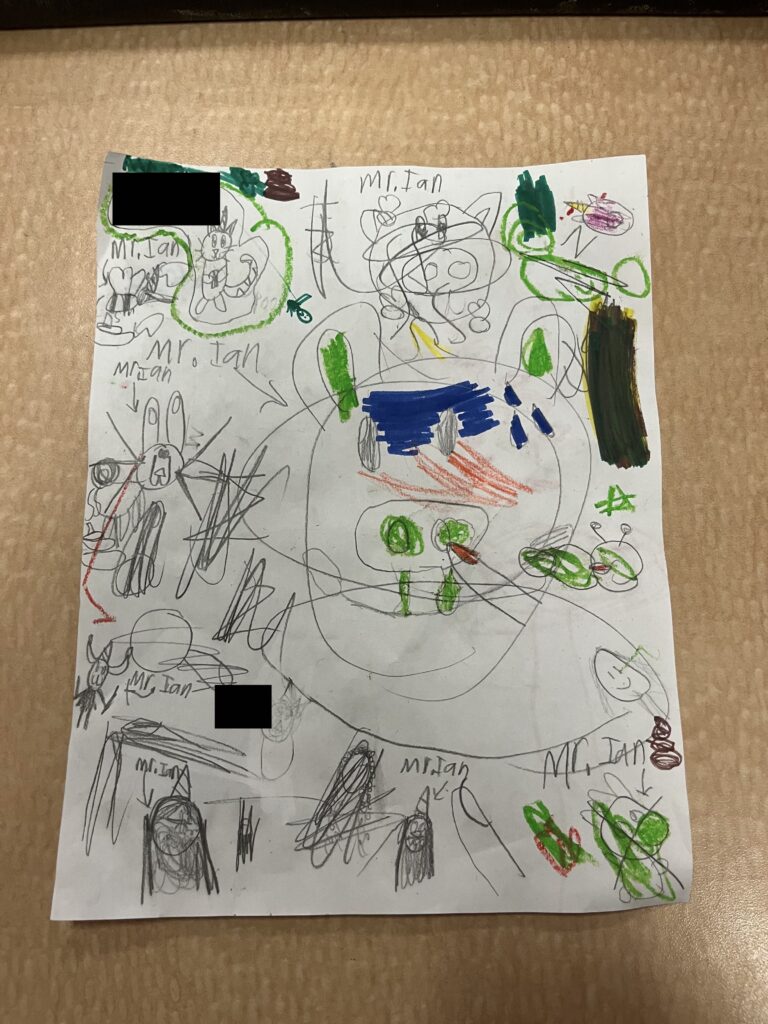
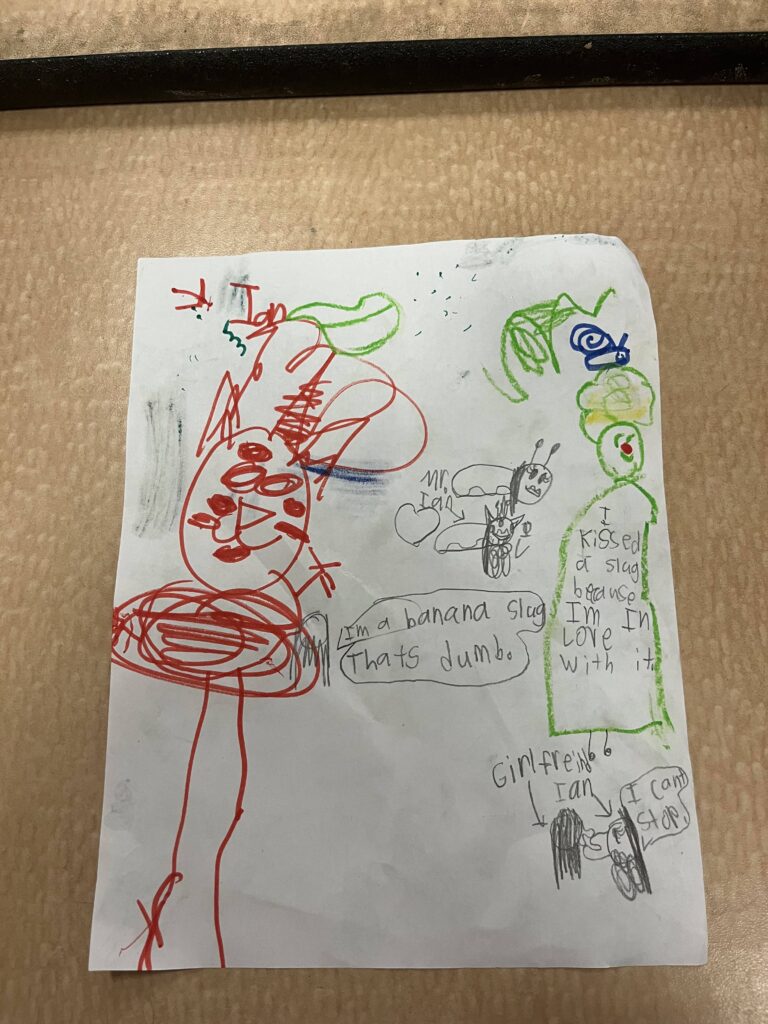
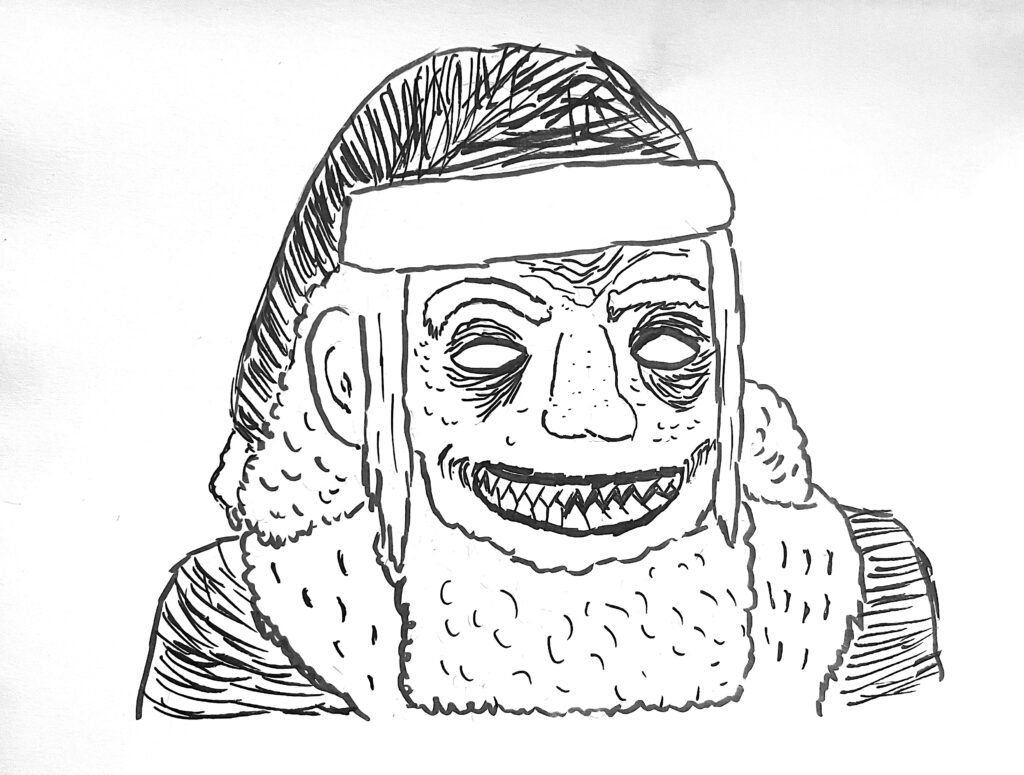
My students (who I affectionately refer to as “the goblins”) decided to draw a couple of portraits of me today. I thought they were fantastic, and with my supervisor’s permission (and the identifying information of the goblins in question removed), I decided to share them with you. Here they are!
I think I want these as my official author photos someday!
When I first moved to Seattle, it snowed a few days every winter. Not a lot, only a few inches, but the city shut down because of it. For some reason, Seattleites are unable to handle the smallest number of flakes, and grocery stores would be stripped bare, as if an apocalypse was at hand.
It hasn’t snowed this winter.
I don’t know if that’s just an anomaly or if that’s going to be the pattern going forward. The climate is fucked. I don’t know if it’s irrevocably fucked, but the people in power show no interest in un-fucking it. Maybe within my lifetime, snow in Seattle will be a distant memory.
Perhaps more distressing, I’ve heard that, due to climactic changes, it will be impossible to grow coffee at large scales within a few decades. Coffee needs a very specific biome to grow in, and that biome will very soon be gone. This has vast implications for Seattle far beyond not having snow. What are we supposed to do if we don’t have coffee? Go to a cafe and pop an Excedrin?
Change is the constant of the universe. That doesn’t mean all change is good, unfortunately.
~ Ian (listening to Wasting Light by Foo Fighters)
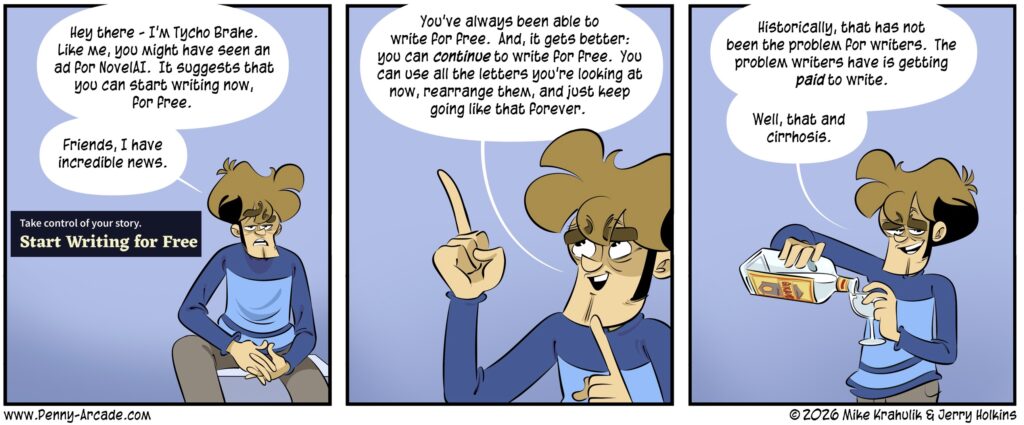
My friend and fellow Resnick Award nominee Jason Boyd sent me this Penny Arcade comic from a few days ago:
Screenshot
That last panel… woof.
(As a side note, I’ve actually met Jerry Holkins in person. I think that if you spend enough time in tabletop gaming stores in Seattle he will just make himself manifest. As I recall, he was buying Age of Sigmar figurines.)
Aside from the perils posed by the other issue discussed in that last panel (I speak as someone who has, on occasion, consumed a wee bit too much of humanity’s favorite recreational hydrocarbon), there’s a lot to be said about the act of “creation” under AI that I still have a lot of thoughts about. As far as I can tell, the proponents of AI-based “writing” tools seem to have this belief that the reason writers write is to have a salable produce at the end of it – that the point of writing is to have written. In this worldview, books and stories are entirely fungible, and the act of creation is a burdensome chore. Think of how much time you’ll have, they imply, now that the boring writing part is out of the way!
I think that, all things considered, if I had more time to write, I would probably spend that time writing.
Perhaps I should view this narrow, ultracapitalist view of artists and creation as sad, or reprehensible. But I mostly find it confusing. For people who make tools that are ostensibly intended to help artists, I wonder if these tech bro AI proponents have actually ever interacted with an artist in any meaningful way. Or, perhaps, do they only socialize with other brogrammers in their spare time, and their worldview is so warped by that tiny echo chamber?
This is largely the same reason why I don’t argue with fundamentalist Christians. Not because I think that they’re right, but because it would be impossible. The parameters by which our worldviews operate are so fundamentally different that communication couldn’t exist between us. In order for a discourse to occur, there has to be some kind of consensual reality that we can use as a basis. Otherwise, it would be like trying to discuss which pizza topping is best, only to learn halfway through an increasingly heated argument that when your interlocutor says pizza, they mean small cherrywood box filled with decorative painted thimbles from the Scandinavian region. There is an inherent incompatibility that becomes impossible to overcome.
If you see nothing fundamentally different between a book written by a human and a hundred thousand words of Markov-chain generated text, maybe AI writing tools are a good idea to you. I suppose they both contain letters and words, and can be held in a .doc file. But if that’s the case, then you must genuinely believe that there is no difference between a human and a Markov-chain computer program, and when you’ve reached that point, our universal parameters are so contradictory that communication between us is impossible.
I continue to not be writing very much, at least writing that’s intended to be published in any real form. I don’t know if I’m supposed to feel guilty or not because of that. I assume I shouldn’t, because I don’t feel guilty, but it still feels weird. When I’m in the swing of things, I usually write about a thousand words a day. This doesn’t feel that impressive to me. When I was a teacher in Madrid, I mentioned to one of my fellow auxiliares, a grad student from Swansea in Wales, that every day after school got out, I went to a cafe and wrote 2000 words. He was astonished. “How long does that take you?” he sputtered.
I was confused. “Like, maybe an hour and a half?”
“It would take me five hours to write that much! How are you so fast?”
I shrugged. “Autism.”
It sounds flippant, but it’s not. My brain’s ability to hyperfixate means that, when I get into the groove of something (especially something I’m interested in), I can block out the entire world and hone in on just that one thing for effectively indefinitely. There are drawbacks, but honestly, considering how they are in so many other ways, it’s surprising to me that neurotypicals can be productive writers. I mean, how can you be productive on a book if you’re spending all your time dating or having a family or a career or such other unnecessary fripperies?
Still, aside from minor touch-ups on a few short fiction pieces, I haven’t written anything meant for publication in weeks. I was talking with a friend before our biweekly D&D session, however, and she said something that was more profound than I think she realized. “It’s okay to have a fallow period every once in a while,” she told me. I immediately thought, Fallow. What a great metaphor. As I’m sure all history nerds know, in a crop rotation system, a fallow field is hardly unproductive. Rather, it’s a critical part of replenishing the soil with nitrogen so that the field can be even more fertile the next season. Especially if you graze livestock in that fallow field so you can get still have some productivity out of that field that year. I just have to let the goats of daily experience poop in my brain so that my mind-field is re-nitrogenated, thus allowing much more fertile story-crops.
Does this metaphor make sense? I think this metaphor makes sense.
In any case, just because my story-field is currently fallow doesn’t mean that I haven’t been creative. Rather, I’ve rotated into writing lore and backstory for my D&D campaign. This is pleasant because there’s not much pressure to perform. My players are some of my best friends. I know that, no matter what, they will be a receptive audience, even if agents and short story markets might not be. Besides, writers love coming up with lore. I can think of several fantasy series that I’m sure primarily exist so the author can tell you all the neat lore they’ve come up with. It certainly can’t be because of the characters or the plots, because they’re not good or interesting. Ideally, I want the lore in my stories to be a side element. But that doesn’t mean that I don’t enjoy making it, and this gives me an excuse.
Also! I had a conversation with an editor I met at DragonCon this last summer. He’d given me his business card, so I figured that it would be cool to reach out, and he was very kind in letting me ask him questions about the publishing industry and the way it be. Specifically, I wanted to know why, for the last few years, I’ve found it very difficult to get agents to request full manuscripts, when in the past I actually had agents reaching out for more writing rather frequently. He said that it’s not just me. Because of how everything generally is, sales are down across the publishing industry, and as such, agents are far less willing to take chances on unknown writers, especially if the writing defies easy categorization. The most important thing, he said, is to do the same thing that I’m already doing: keep writing, keep revising, keep querying. The number one thing that separates successful from unsuccessful writers is the same as it ever was: sheer, bloody-minded, pig-headed determination.
At the very least, I can at least rest easy that, as always, there’s nothing wrong with me. It’s capitalism’s fault!
I haven’t been updating this blog lately. There’s a very simple reason why: I haven’t been writing lately. I’ve been utterly overwhelmed with everything that’s been going on in the world lately, and especially here in the United States. I know that my country hasn’t always been the shining beacon of goodness and democracy that it has claimed to be, but I do think that overall, America has tried to do the right thing for the world, even when that has been misguided or just plain wrong. To see the events in Minneapolis recently, alongside the threat of a pointless war with Europe and the crumbling of eighty years of the post World War II world order, has been almost more than I can handle. Everything sucks these days, and for all the last month, I haven’t been able to work on anything except in the most desultory manner.
But in times of trouble, like many people, I take comfort in my holy book. For me, that is probably Lord of the Rings.
Yeah, it’s a cliche to say that I encountered Lord of the Rings and The Hobbit and had my entire personality and worldview changed. I’m not the only one. Be glad that it was Tolkien that triggered my writing obsession, not Robert Heinlein or Ayn Rand.
If there are any lessons to be taken from Lord of the Rings, it’s that anyone, even the smallest among us, has the ability to change the world, and that no one, not even the most wretched among us, is beyond “pity”, as Tolkien put it, or empathy, as I would more likely phrase it. But that’s not what gives me comfort in this moment. No, it’s the chapter where the Isengard orcs kidnap Merry and Pippin in order to, as the meme says, “take the hobbits to Isengard”.
The reason why Merry and Pippin are able to escape the orcs isn’t because they overpower them with strength of arms. It’s because the orcs kill each other. The orcs are composed of three different groups striving for dominance: the warrior Uruk-Hai, the orcs of Mordor, and the goblins of the Misty Mountains. The squabbling and posturing between them eventually leads to a massacre, because that’s what always happens among evil people. They will always destroy each other through the force of their own hatred and stupidity.
The only way you can get evil people to work on a unified goal is when someone even stronger and more evil forces them to submit to their will. And, fortunately, the man who is the eye of the storm of darkness consuming my country is not strong. He is a fat, demented slug of a man, a lazy narcissistic coastal elite who, for some reason, has managed to grift millions into thinking he’s a working-class hero, with no interests or desires aside from satisfying his own vanity and enriching himself. And you just have to look at him – the softness in his body, the deadness in his eyes – to know that he’s not long for this world. Once he’s gone, who do you think can wield the kind of strength and cruelty that can keep his minions in line? J.D. Vance? Kristi Noem? Stephen Miller?
For people who claim to be Christians, the current government clearly hasn’t learned the gospels’ warning re: houses built on foundations of sand. Only in this case, they’ve built their empire on a foundation of fat, saggy flesh, piloted by a brain that is just a couple Filet-O-Fishes away from a hemorrhage so powerful it could kill God. The greatest enemy of evil is evil.
I’ll finish with the following quote by Tolkien himself, from “On Fairy Stories”:
In what the misusers of Escape are fond of calling Real Life, escape is evidently as a rule practical, and may even be heroic. In real life it is difficult to blame it, unless it fails; in criticism it would seem to be the worse the better it succeeds […] Why should a man be scorned if, finding himself in prison, he tries to get out and go home? Or if, when he cannot do so, he thinks and talks about other topics than jailers and prison-walls? The world outside has not become less real because the prisoner cannot see it. In using Escape in this way the critics have chosen the wrong word, and what is more, they are confusing, not always by sincere error, the Escape of the Prisoner with the Flight of the Deserter. Just so a Party-spokesman might have labeled departure from the Führer’s and any other Reich and even criticism of it as treachery […] Not only do they confound the escape of the prisoner with the flight of the deserter, but they would seem to prefer the acquiescence of the ‘quisling’ to the resistance of the patriot. To such thinking you have only to say ‘the land you loved is doomed’ to excuse any treachery, indeed to glorify it.
It is our duty to resist. It is our duty to love. It is our duty to dream of other, better worlds, no matter how many orcs or balrogs or Nazgûl stand against us.
Besides, all things are temporary. This will end. We will remain.
~ Ian (listening to the soundtrack to O Brother, Where Art Thou?)
2025 wasn’t an awesome year for a lot of reasons. Fortunately, it was a great year for music. Actually, every year is a great year for music: so many amazing bands and artists are popping up everywhere, and while only a tiny handful of them are able to actually make a living off their art (just like artists in all media, in this dystopian future we live in), this doesn’t prevent the fact that music is just as good and as vibrant as ever.
With that in mind, I thought I’d present my top 5 albums of 2025, along with a few honorable mentions. I’m well aware that these albums skew towards the metal side of things. That just happens to be what I like, and I make no apologies for it. Sorry.
Honorable Mentions: Mourning You, Bonnie Trash; CONFLICT DLC, HEALTH, Pink Floyd at Pompeii – MCMLXXII, Pink Floyd; Talking Machine, The Wytches; Year of the Cobra, Year of the Cobra
Te Rā, Alien Weaponry
Alien Weaponry is a sort of Pacific Islander Sepultura, mixing brutal thrash and groove metal riffs with imagery drawn from the band members’ Maori heritage. In fact, over half of the songs on Te Rā are either in the Maori language or blend Maori and English lyrics, and they hit hard. The percussive nature of Polynesian languages that make them so suitable for haka and war chants also makes them perfect for thrash. The standout track for me is “Mau Moko”, which mixes Meshuggah-like polyrhythm breakdowns with lyrics about the traditional Maori practice of facial tattoos called “moko”– we are the people who wear moko, the English translation of the chorus goes. Absolutely killer riffage mixed with indigenous identity and trauma, as well as mythology that goes well beyond the typical Nordic mythos that most metal, for better or for worse, sticks close to.
Rivers of Nihil, Rivers of Nihil
It’s not a huge innovation for a band to make use of the clean vocalist/distorted vocalist dichotomy, but I don’t know many bands who do it more effectively than Pennsylvania-based progressive death metal band Rivers of Nihil. After their recent lineup change, they shifted clean vocalist/bassist Adam Biggs to the lead singer position, and it brings out so much more emotional resonance in their music. This, combined with an increased use of electronics, pushes Rivers of Nihil more into prog rock territory than some of their previous work, which was much more on the tech-death side of the aisle. They’re still able to be crushingly heavy at times, but on tracks like “Water and Time”, they can achieve a beauty that’s almost transcendent.
METAL FORTH, BABYMETAL
No group in the last fifteen years has been able to expand metal’s frontiers with such unbridled joy as kawaii metal pioneers BABYMETAL, and METAL FORTH is just another boundary-shattering, genre-defying whirlwind. This time, producer Kobametal brought in a different collaborator for nearly every track, pushing BABYMETAL’s transgressive sound even further with the help of six amazing guest artists and also Spiritbox. Every track has a completely different flavor, from Electric Callboy’s sleazy EDM-meets-metalcore beats on “RATATATA”, the Bollywood grooves and nü-metal breakdowns on “Kon! Kon!” (featuring Bloodywood), and the kabuki-and-Tom Morello mashup of “METALI!!” Besides, I can’t think of any artist who’s better at making metal fun quite like BABYMETAL. Their tongues are firmly in cheek on METAL FORTH, and yet it doesn’t sacrifice a bit of the massive riffs and infectious J-pop hooks that made BABYMETAL superstars.
Labyrinthine, Faetooth
I’m extremely fond of doom metal bands with female vocalists. Bands like Alunah, Year of the Cobra, Suldusk, Sylvaine, Windhand, and Blackwater Holylight feature prominently in my discography. A band that cropped up recently that fits this category perfectly is Faetooth, an all-female doom band based out of LA. Their music manages to be both hauntingly ethereal and crushingly heavy all in the space of a single song. And Faetooth also manages to bring in folk and black metal touches to their sludgy core. Definitely a rising band to follow if you’re into the slower, gnarlier side of the extreme metal universe.
Age of Aquarius, Perturbator
The amount of range that synthwave maestro James Kent is able to cover in one album is astonishing. After taking a detour into ambient metal with Final Light in 2022, his main project, Perturbator, has returned to chilly electronic beats redolent of the cyberpunk future that never was. Each track on this album feels like neon lights reflected in a nighttime puddle. What’s more, Age of Aquarius can transition from one wildly divergent mood to another within the space of just a single track, like going from the Vangelis-inspired ambient synth textures and swirling saxophone of “Hangover Square” into the throbbing techno breakbeats of “The Art of War”. Kent also works with an impressive variety of collaborators, from industrial metal composer Author and Punisher to French blackgaze trailblazers Alcest. The standout track is probably “Lady Moon”, with eerie vocals by frequent collaborator Greta Link.
There’s plenty of great artists to check out these days, and if you have similar tastes to mine, you might consider giving these artists a try! And if you like them, please support them through buying merch or physical media, or going to their shows. Streaming services pay artists the barest fraction of a pittance, and so many great musicians and bands depend on merch and live shows to keep existing. Let’s hope 2026 has just as many awesome tunes!
Apologies for all my legions of fans who weren’t able to access the website these last few days. The servers on which ianthewriter.com is stored are in Santa Cruz, which has just been hit by a series of power outages, and my webmaster (also known as my dad) and I were on a ski trip for Christmas, so we couldn’t reboot the machine until we got back, and then my dad discovered that the whole machine was borked, so he had to go get a replacement server before my website could go up, so it was a huge fustercluck… That’s the price to pay for not storing your data on an AWS server, I suppose, but it’s worth it if it means I can have my own online space without having to bend the knee to one of the lawful evil gigacorporations that have carved the internet up into their own personal fiefdoms. And hey! Since I haven’t done a post about the Books I’m Enjoying this month, now’s a perfect time to do so before the year ends.
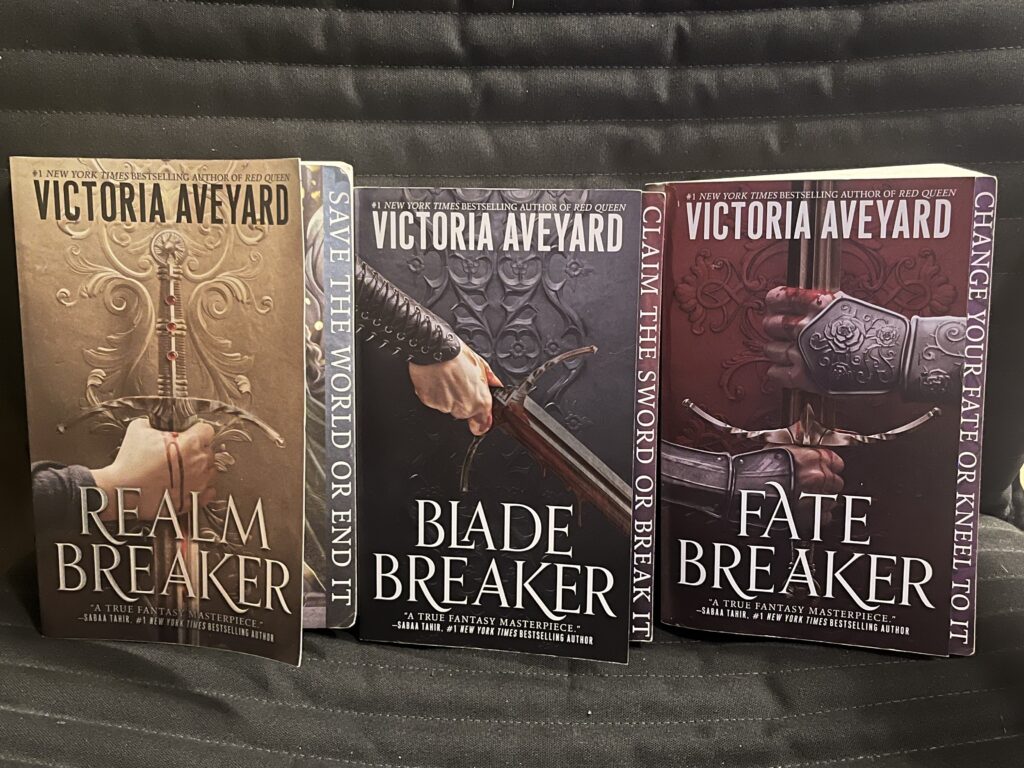
Realm Breaker, Victoria Aveyard
I picked up this series last year after the election. I needed an escape badly at the time, as I’m sure millions of others did, and it was exactly what I needed. Since I’m working on a lot of YA fiction, I decided to revisit this series. It contains dimensional travel, an evil queen, demonic sorcery, magic swords, an epic war against all-consuming darkness, and true love. The author, Victoria Aveyard, said in her acknowledgments that this series was her tribute to all the classic fantasy she’d read growing up, especially Tolkien. Considering that one of my initial reasons for starting writing was that I wanted to be the person who had written Lord of the Rings, I vibed pretty hard with that sentiment. At the very least, Realm Breaker is an excellent comfort read.
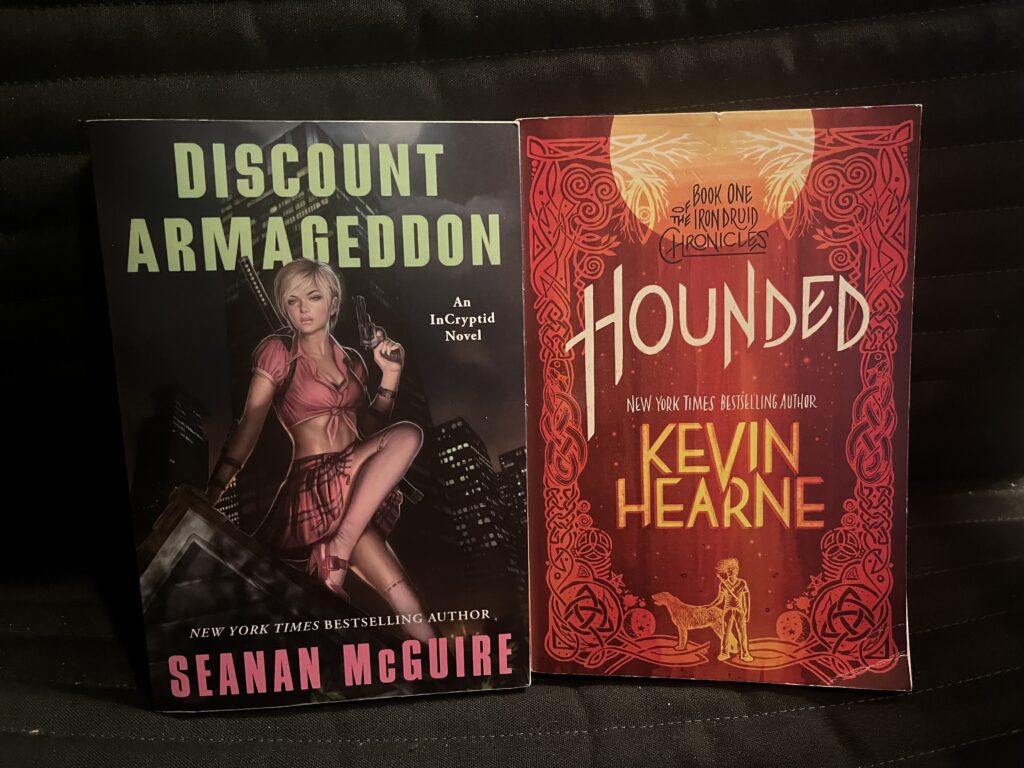
InCryptid by Seanan McGuire and the Iron Druid Chronicles by Kevin Hearne
Talking of comfort reads, I’ve always had a soft spot for urban fantasy novels starring snarky, witty protagonists. Blame my best friend Kalila, who got me into Buffy the Vampire Slayer at an impressionable age. I picked up both of these series lately and have been working my way through them in parallel. The InCryptid books are about a human family that studies and defends the many cryptids of North America, and they’re written by Seanan McGuire, who is basically who I want to be when I grow up. The Iron Druid Chronicles are about a two thousand year old Irish druid based out of Arizona and his run-ins with various gods, witches, and malevolent entities. Both of these series go down smooth. I can polish off one of these books in about a day or so, which is what you want, sometimes.
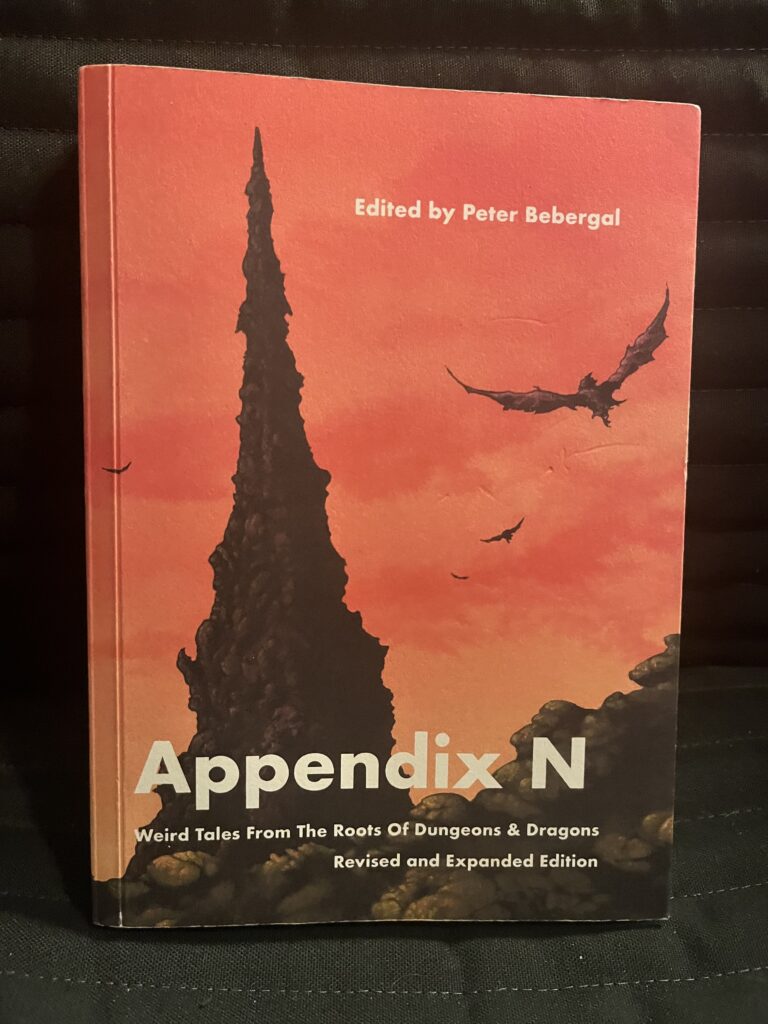
Appendix N: Weird Tales From the Roots of Dungeons & Dragons, edited by Peter Bebergal
I’m firmly of the opinion that it’s impossible to understand any genre or medium if you don’t have a good knowledge of its history. So many fantasy writers and gamemasters don’t seem to realize that the genre has roots that go further and deeper than Tolkien, and so much of that history can make for excellent inspiration for enthralling stories and games. This collection of curated tales from the famous “Appendix N” at the end of the original Players Handbook provides a wide overview of some of the writers whose influence on gaming is often overlooked: Lord Dunsany, Robert Howard, Michael Moorcock, C.E. Moore, and so many others. It’s especially enjoyable to be able to dip into a wholly unique fantasy world for just a short story. Short fiction set in secondary world fantasy settings is rare these days (although some markets, like Beneath Ceaseless Skies, provide an excellent home for those stories), so being able to experience new settings and characters without having to commit to a whole seven-volume trilogy is a nice treat.
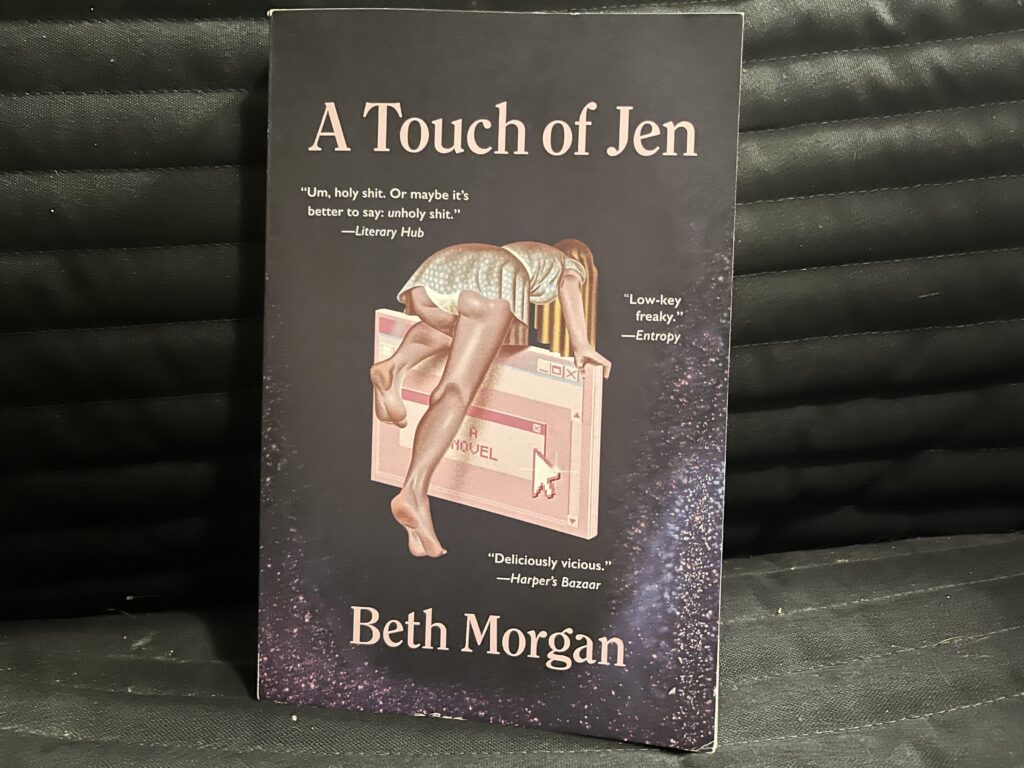
A Touch of Jen, Beth Morgan
I love stories about horrible people failing in entertaining, catastrophic ways. Not many people can say that It’s Always Sunny in Philadelphia is one of their comfort watches, but I’m a weirdo in that sense, I suppose. Keep that in mind when I tell you that the characters in A Touch of Jen are some of the most compellingly terrible weirdos I’ve encountered in a long time. This book is absolutely unhinged in the best way. It follows the story of a millennial couple who are both obsessed with one of their former coworkers, a globetrotting jewelry designer and influencer whose every Instagram post they devour. When the object of their obsession invites them on a surfing trip, it sets off a series of cascading incidents that destabilize the lives of every person in their orbit. I won’t spoil the directions that this book goes, largely because I was surprised by them as well. Let’s just say that it takes a lot to catch me off guard in a narrative, and A Touch of Jen did so about five or six times.
Comfort stories are a bit of a theme in today’s post, eh? I suppose that makes some sense. It’s the Fourth Quarter Holiday, after all, a time of cozying up with a blanket and a book, with a cat on top of you and a beverage of your choice at your side. I’ve got one more post planned in the next few days, about my favorite music that was released this year. Hope you’ll stick around to read it! I promise one of the albums is not metal, at least not entirely.
~ Ian (listening to GLORY by Teen Jesus and the Jean Teasers)
My friend Tim makes beer. He’s actually really good at it. He has this beer that he brews with chamomile that, if I had it at a microbrewery or a good pub, I would consider to be one of my favorites of the year. The beers are 100% good enough that you could sell them.
And yet, every time I hear someone tell Tim that he should sell his brews, my skin crawls a little bit. There are a few reasons for this. One is that the skillset required to make beer and the skillset for operating a microbrewery form a Venn diagram resembling Meszut Özil’s eyes. Making a business of brewing means producing beer at scale, leasing space to do it in, hiring employees, dealing with finances, arranging distribution and marketing… in short, all kinds of things that don’t involve beer and the making thereof. This is why so many microbrewers fail, even if their beer is excellent. Making stuff and selling it are vastly different endeavors.
But most of the skin-crawly ick that these comments give me comes from something deeper. There’s a casual assumption in society that, if you’re good at something, it’s practically your obligation to monetize it, that creative work is only worth doing if it results in a salable product at the end. Under this paradigm, Tim is actively wasting his time with his homebrew hobby, no matter how much satisfaction the process of brewing gives him, or the joy that his family and friends receive from drinking his beer. Any moment of the day that is not devoted to maintaining basic bodily needs, according to society, is squandered by not squeezing every drop of revenue from it.
It is a genuine tragedy of our culture that doing something for simple enjoyment is considered frivolous if it doesn’t result in a profit. And that’s what creative work is supposed to be: enjoyable. If you make beer, or knit, or paint, or create incredibly detailed tiny wooden sculptures of Bloom County characters, isn’t the pleasure you get from creation inherently worth it?
Then I think about myself and my writing, and I get even more conflicted.
I started writing for a lot of reasons. A lot of it was that I wanted to prove to others that I had value, the asshole students and bullying teachers that I dealt with every day. I thought that being the youngest ever published fantasy writer would win me friends and approval. But once I’d become better at writing, I discovered that I enjoyed it. Everything in my life seemed like work, from school to socializing to just being at home. Because writing didn’t feel like work, I thought that, if I were able to make money doing that, I wouldn’t have to deal with all the difficult life stuff that I hated.
When I was a teenager, I wanted to write a genre-defining epic fantasy novel like Lord of the Rings. Now my goals are more modest. I just want to make a living as a writer so I don’t have to do that work stuff. I’m not there yet– the only money I’ve made is the $100 from the runner-up prize for the Resnick Award. Part of me, though, thinks that if I don’t end up making money as a writer, all of the work I’ve done, all the millions of words, the unpublished novels and short stories and games I’ve written, will have gone to waste.
Is that an attitude that I have genuinely? Or have I somehow bought into the cultural delusion that creative work only has value if it’s profitable? I genuinely don’t know. Whatever the reason, that desire is tangled up with a lot of other things: my need for approval, my fear of failure, my wish to make a living without having to do “real work”. I don’t have any easy answers, and this post won’t provide any answers.
At the very least, it’s hard submitting stories because the publishing industry, as much as it claims to be about literature, is an ultimately capitalist endeavor. The publishing houses, whether they’re Big Five or small press, are in the business of extracting as much money as they can from consumers for the least amount of overhead. This means that publishers and agents are very hesitant to take risks on any new writers or material. They would much rather have something by an established writer whose work is guaranteed to sell, or whatever trend is currently popular. That’s why you saw so many YA vampire romances twenty years ago and dystopian novels ten years ago. Now the trend is for smutty romantasies with titles like A Noun of Nouns and Nouns. It’s harder than ever for new writers to break through.
Where does the line exist between selling out and selling, though? Do I have to change my work to fit in with current market trends? Ultimately that’s a self-defeating practice: it can take two years for a book to go from sale to publication date, so all those Sarah J. Maas and Rebecca Yarros ripoffs that just got six-figure deals will be hopelessly off-trend when they come out. Is my best bet to just write books I like, write works that I think are valuable, and keep submitting until I find an agent or editor who likes my writing for what it is?
I don’t know. All I know is that this short-sighted trend chasing from the Big Five publishers contains the seeds of its own destruction. No one can predict what’s going to be a massive success in publishing (hell, just look at Fifty Shades of Grey), so playing it safe and just doing what sells is ultimately doomed. What sells now might not sell in the future. All those copies of Twilight and Fifty Shades are crowding the shelves at Goodwill. Maybe that doesn’t matter to their authors, who are massively wealthy, or the publishers who have already been paid for those copies. But doing what’s easy or safe, while tempting, is a losing strategy in the long run. The publishing industry, as well as society as a whole, has to learn that soon. Otherwise the future will crush it.