Tag: Books I’m Enjoying

  • Books I’m Enjoying, May 2026

    May is nearly over, but that’s no excuse not to do a Books I’m Enjoying post! It’s hard to believe that it’s almost summer and that 2026 is nearly half over. At the same time, with all the ongoing goings-on, it feels like it’s been 2026 for almost a decade. At least, I felt like I’ve aged a decade in that time. 

    That being said, books continue to come out and remain great, so let’s get into some of them! 

    Destroy All Humans, They Can’t Be Regenerated by Katsura Ise and Takuma Yokota
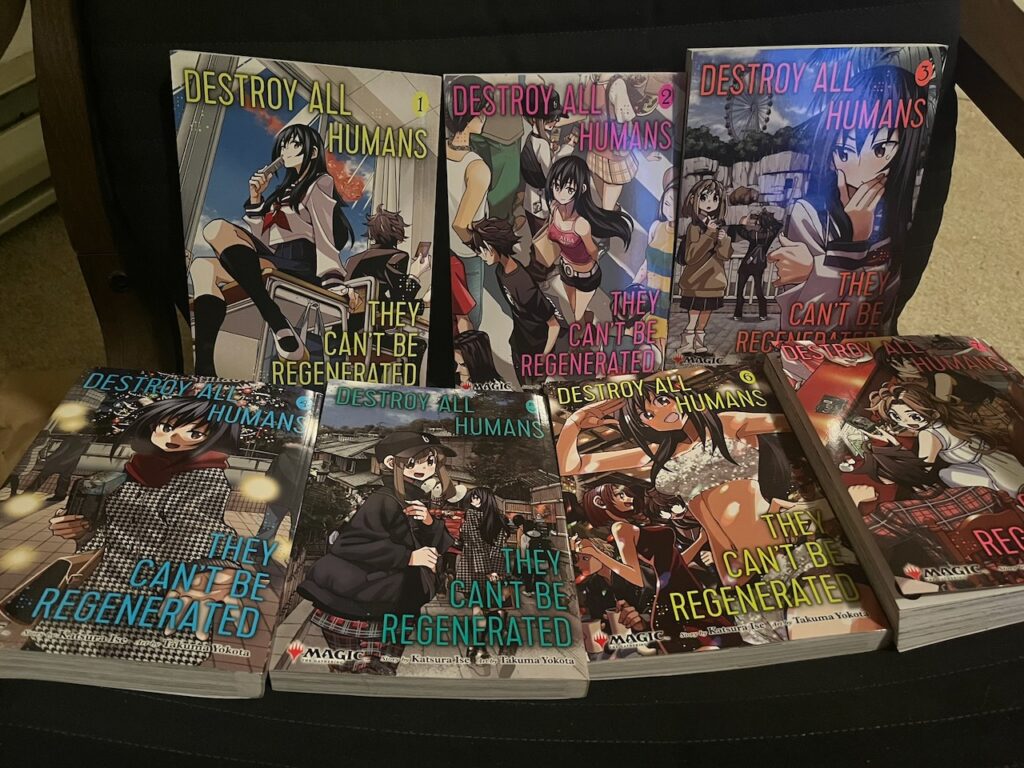
    When I was in elementary school, I got really into Magic: The Gathering, as many people do. I credit MtG for introducing me to algebra, at least when I realized that the X in mana costs didn’t mean ten. And while I don’t play Magic frequently these days (the onslaught of Universes Beyond slop has really turned me off the game), every few years my love of the game returns, like some childhood virus that lingers in my system, occasionally flaring into a disgusting Magic rash. Does this mean that Magic is like shingles? I don’t know. This metaphor makes sense in my head. 

    Anyway, this manga brings back all the nostalgia for that time for me, at least the good aspects of elementary school. Set in 1998, the main characters, Emi and Hajime, are middle schoolers obsessed with Magic who form a friendship despite being academic and social rivals. The art is cute and winsome, and the scenes between the MCs toe the line between funny and heartfelt, often on the same page. I love the rivals-to-friends-to-lovers story arc that Emi and Hajime are going down, and it’s great to see a manga with genuine appreciation for the game and the connections that it makes. I’d be curious, however, if the scenes with card games make any sense to non-Magic players. I understand what’s going on in them because I understand the rules and strategies, but would a normie? 

    Daemons of the Shadow Realm by Hiromu Arakawa
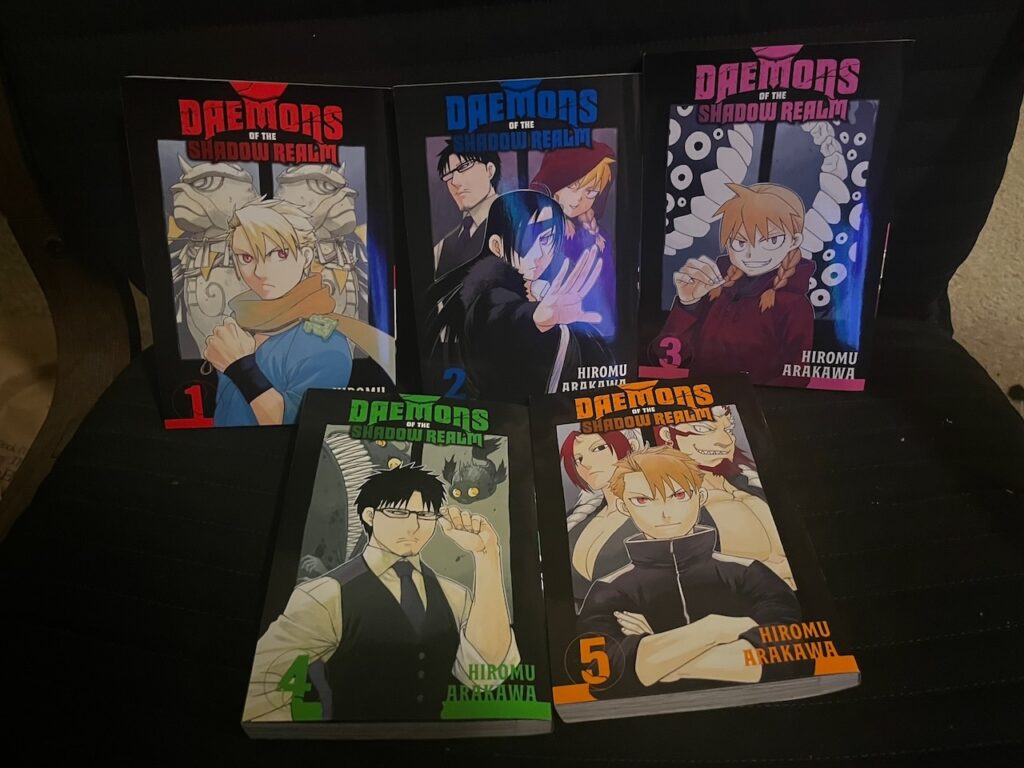
    Hiromu Arakawa is a manga legend. She created Fullmetal Alchemist, which so many otaku consider to be one of the greatest manga and anime of all time, and if she just retired after FMA to bask on her laurels, I would understand. But in recent years, she’s created a new series about two siblings, Yuru and Asa, raised in a hidden mountain village that comes under attack from the modern world, and who command paired daemons. Daemons of the Shadow Realm has all the shonen action and compelling magic that characterizes FMA, set in an alternate modern-day Japan. Fans of the Elric brothers will not be disappointed! (I think? It feels weird to talk about books as if I’m writing a review column for Kirkus, but maybe that’s what this is? Ah well. Es lo que hay.

    Beyond the Clouds: The Girl Who Fell From The Sky by Nicke
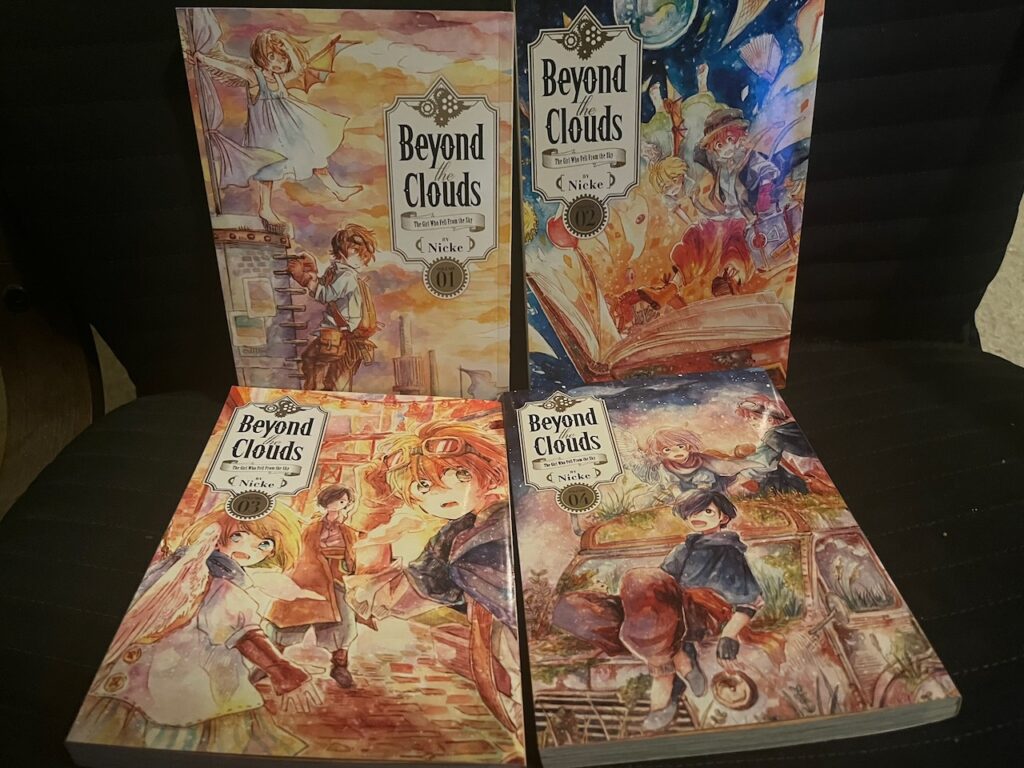
    I swear I’ve been reading more than just manga lately! This series, however, is something special. It’s about a ten-year-old winged girl named Mia who falls from the sky, then awakens in an industrial city called Yellow Town with no memory and no ability to get back to the sky. Fortunately, an engineer boy named Theo constructs a mechanical wing for her. But when she starts manifesting bizarre magic powers, they leave Yellow Town on a quest to learn how to control Mia’s magic. Nicke’s art is lush and appealing, her steampunk-inspired setting feels so real you could jump into it, and the adopted sibling relationship between main characters Theo and Mia gives all of the feels. If you like early Ghibli films like Laputa and Nausicäa of the Valley of the Wind, this should hit you just right. I assume. 

    (By the way, interesting fact, in Spanish, Laputa was renamed to Lapita, because la puta means something obscene. Being bilingual is fun!)

    Gormenghast Trilogy by Mervyn Peake
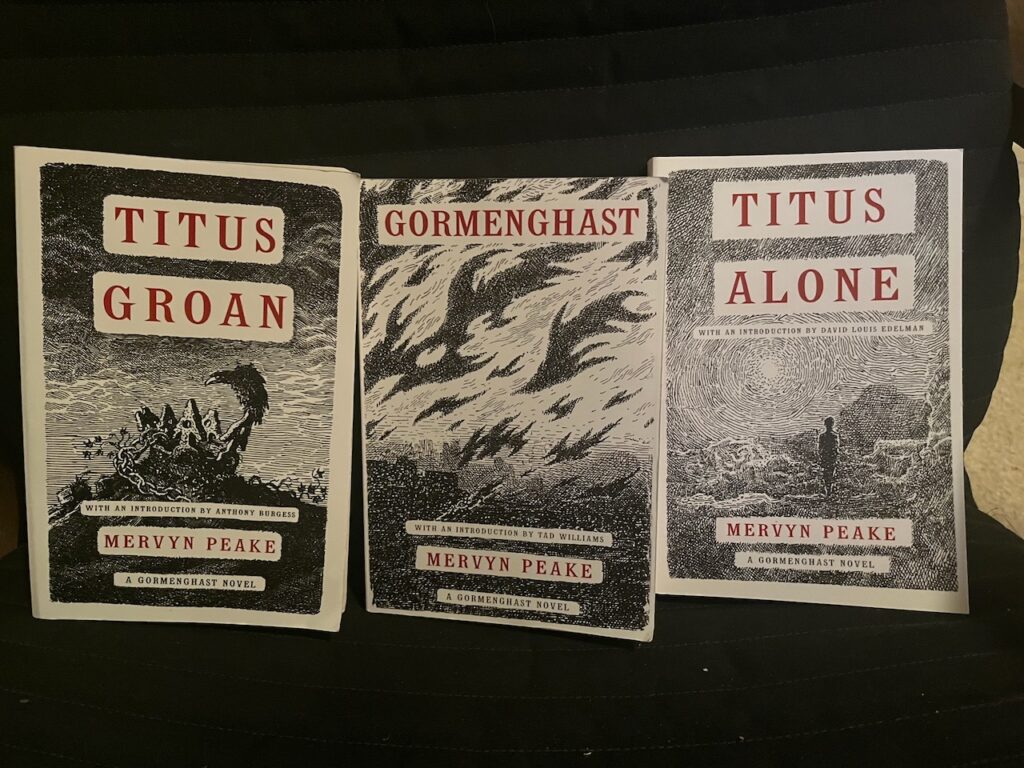
    See? I can read books without pictures in them – although Mervyn Peake was, in addition to being a transformative writer, an illustrator of great talent. His black-and-white line drawings accompany the text, and they are just as haunting and unsettling as the words, putting Peake in a category with other dark fantasy authors/illustrators like Clive Barker and Brom. 

    The Gormenghast books are difficult to describe. They lie at the boundary between fantasy, gothic horror, and surrealism. Ostensibly, they’re about Titus Groan, seventy-seventh Earl of the castle of Gormenghast, but at the same time the series is about Gormenghast, with the motley cast of characters (wicked Steerpike, doomed Fuschia, darkly comic Doctor Prunesquallor and his spinster sister Irma, among many others) acting almost as personas within the psyche of the castle itself. This isn’t an original observation – any gothic tale from Castle of Otranto onwards is as much about setting as it is character – but it’s reinforced by the madness that the oppressive setting places on Titus and his household. The Gormenghast books were a huge influence on my literary hero Michael Moorcock, who I would like to be when I grow up, and I can definitely see a connection between the grotesques of Titus Groan and the emotionally-warped weirdos that populate the Elric books. 

    Tapping the Dream Tree and Spirits in the Wires by Charles de Lint
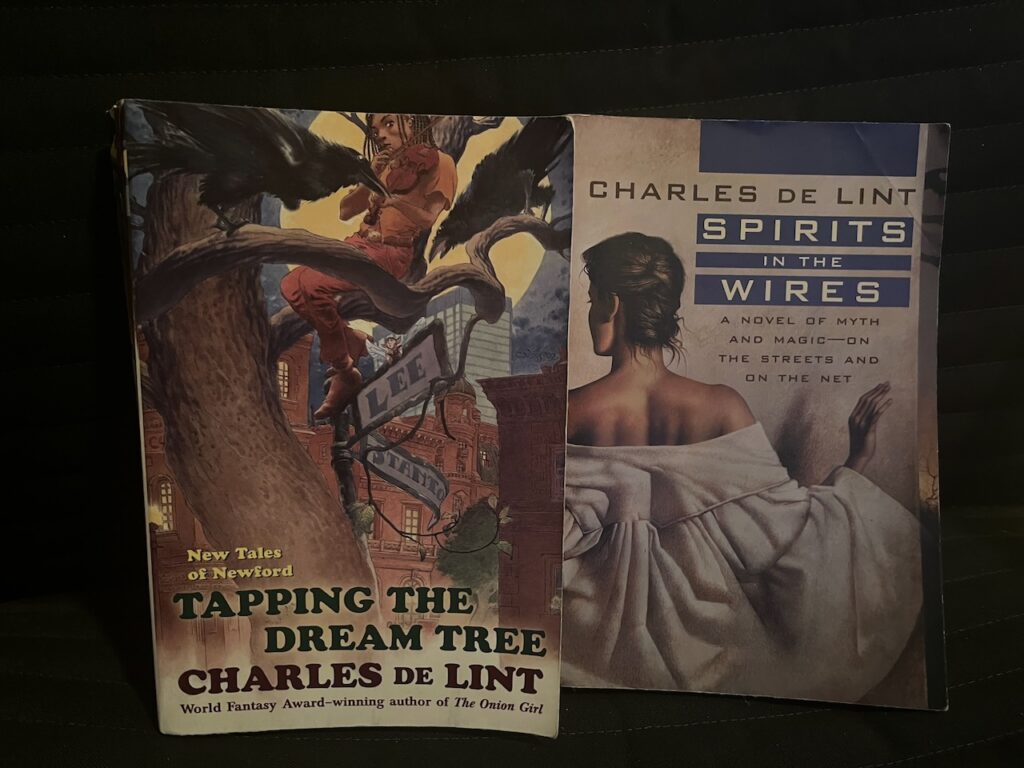
    I’ll finish with these two contemporary fantasies by Charles de Lint, both set in his magical realist city of Newford. The first is a selection of short fiction that blends urban life with fantasy in de Lint’s inimitable way, and the second is a novel about a website called the Wildwood that has magical properties. I was especially fascinated with Spirits in the Wires because it depicts an older version of the internet that has been lost to time: an era without social media companies and online megastores dominating every aspect of our online lives, a time of webrings and animated GIFs and MUDs, an age when you could just spin up a website with a rudimentary knowledge of HTML and a server to host it on. It’s a vision of the web, in short, that’s much like the internet that I knew when I was a kid, a boundless resource that may have been irrevocably destroyed by some of the worst people in history. 

    As an aside, I bought my copy of Spirits in the Wires at the Half Price Books in Lynnwood, and somebody had marked it up in a few places with ballpoint pen. Whoever did this made various grammar corrections, as if trying to show that they were so much smarter than the author. What’s worse, they didn’t even correct the grammar in the right way. It’s perfectly acceptable to use the objective case with comparisons (like more girly than me rather than more girly than I), especially in casual speech, and anyone still sticking to those archaic syntactic rules makes me think of a purse-lipped spinster English teacher with her glasses on a chain, sneering down her nose at her students who have the temerity to split an infinitive or use they as a singular pronoun. Did the existence of more contemporary grammar than was acceptable in 1920 send this person into such paroxysms that they had to write their “corrections” in ink, then donate it to a used bookstore where it could no longer offend them? 

    At least there weren’t that many comments and this wasn’t a library book. There is a special place in hell for people who ink commentary in library books, alongside those who defile innocence and people who talk in the theater. 
  • Books I’m Enjoying, December 2025

    Apologies for all my legions of fans who weren’t able to access the website these last few days. The servers on which ianthewriter.com is stored are in Santa Cruz, which has just been hit by a series of power outages, and my webmaster (also known as my dad) and I were on a ski trip for Christmas, so we couldn’t reboot the machine until we got back, and then my dad discovered that the whole machine was borked, so he had to go get a replacement server before my website could go up, so it was a huge fustercluck… That’s the price to pay for not storing your data on an AWS server, I suppose, but it’s worth it if it means I can have my own online space without having to bend the knee to one of the lawful evil gigacorporations that have carved the internet up into their own personal fiefdoms. And hey! Since I haven’t done a post about the Books I’m Enjoying this month, now’s a perfect time to do so before the year ends. 

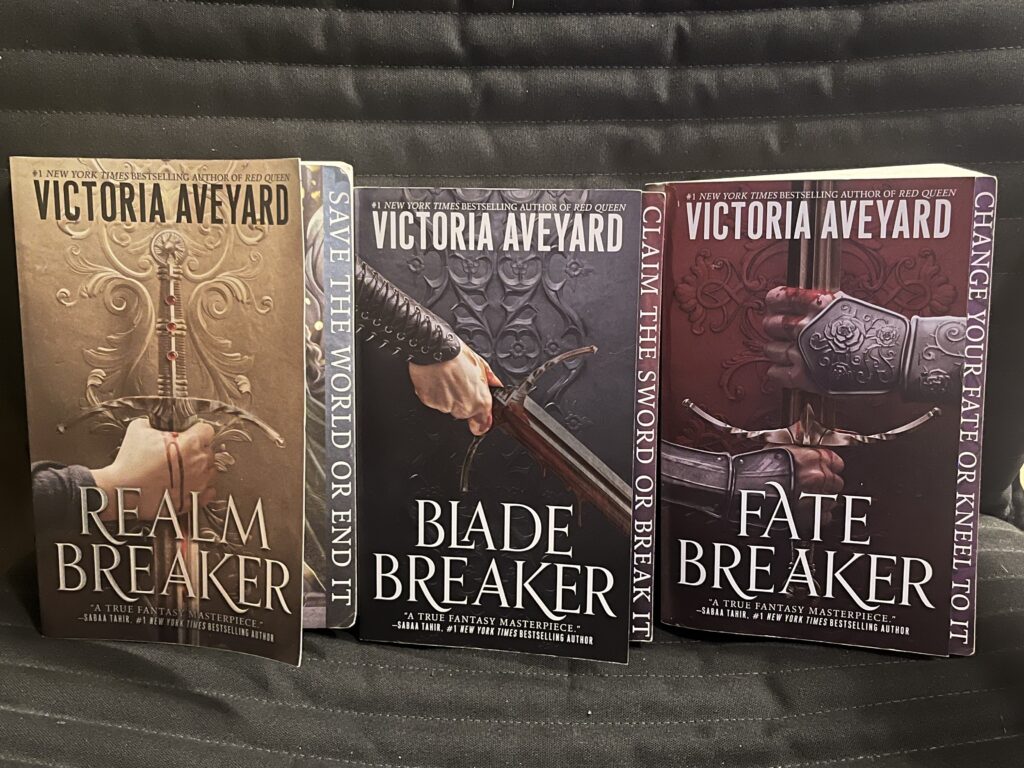
    Realm Breaker, Victoria Aveyard

    I picked up this series last year after the election. I needed an escape badly at the time, as I’m sure millions of others did, and it was exactly what I needed. Since I’m working on a lot of YA fiction, I decided to revisit this series. It contains dimensional travel, an evil queen, demonic sorcery, magic swords, an epic war against all-consuming darkness, and true love. The author, Victoria Aveyard, said in her acknowledgments that this series was her tribute to all the classic fantasy she’d read growing up, especially Tolkien. Considering that one of my initial reasons for starting writing was that I wanted to be the person who had written Lord of the Rings, I vibed pretty hard with that sentiment. At the very least, Realm Breaker is an excellent comfort read. 

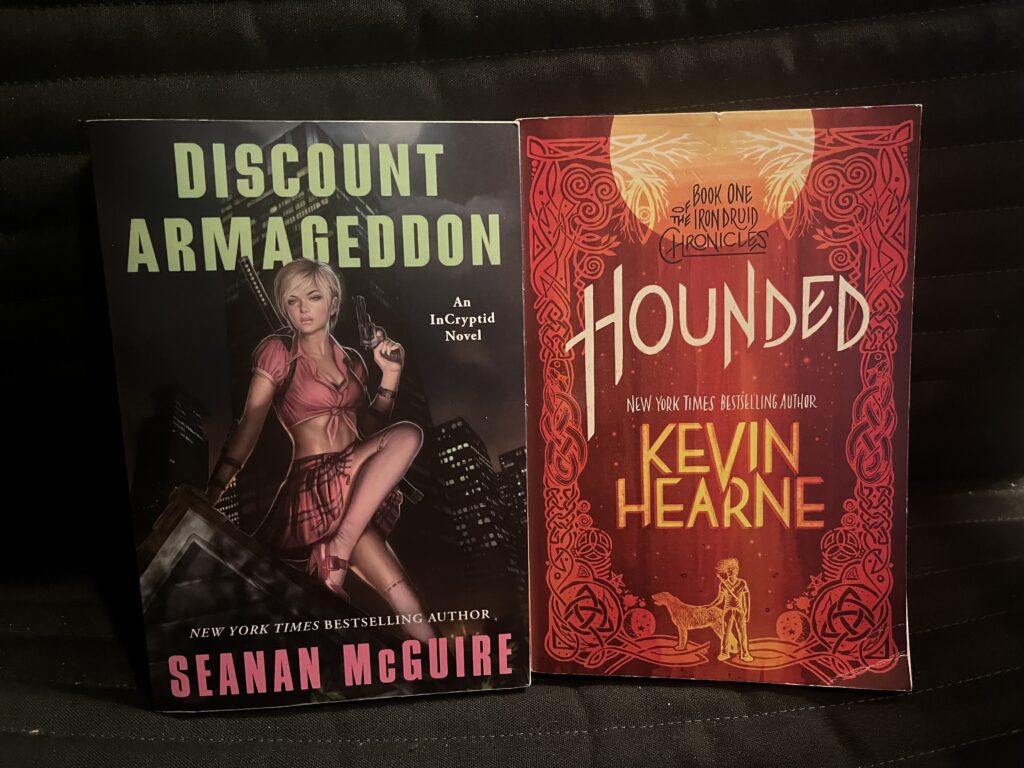
    InCryptid by Seanan McGuire and the Iron Druid Chronicles by Kevin Hearne

    Talking of comfort reads, I’ve always had a soft spot for urban fantasy novels starring snarky, witty protagonists. Blame my best friend Kalila, who got me into Buffy the Vampire Slayer at an impressionable age. I picked up both of these series lately and have been working my way through them in parallel. The InCryptid books are about a human family that studies and defends the many cryptids of North America, and they’re written by Seanan McGuire, who is basically who I want to be when I grow up. The Iron Druid Chronicles are about a two thousand year old Irish druid based out of Arizona and his run-ins with various gods, witches, and malevolent entities. Both of these series go down smooth. I can polish off one of these books in about a day or so, which is what you want, sometimes. 

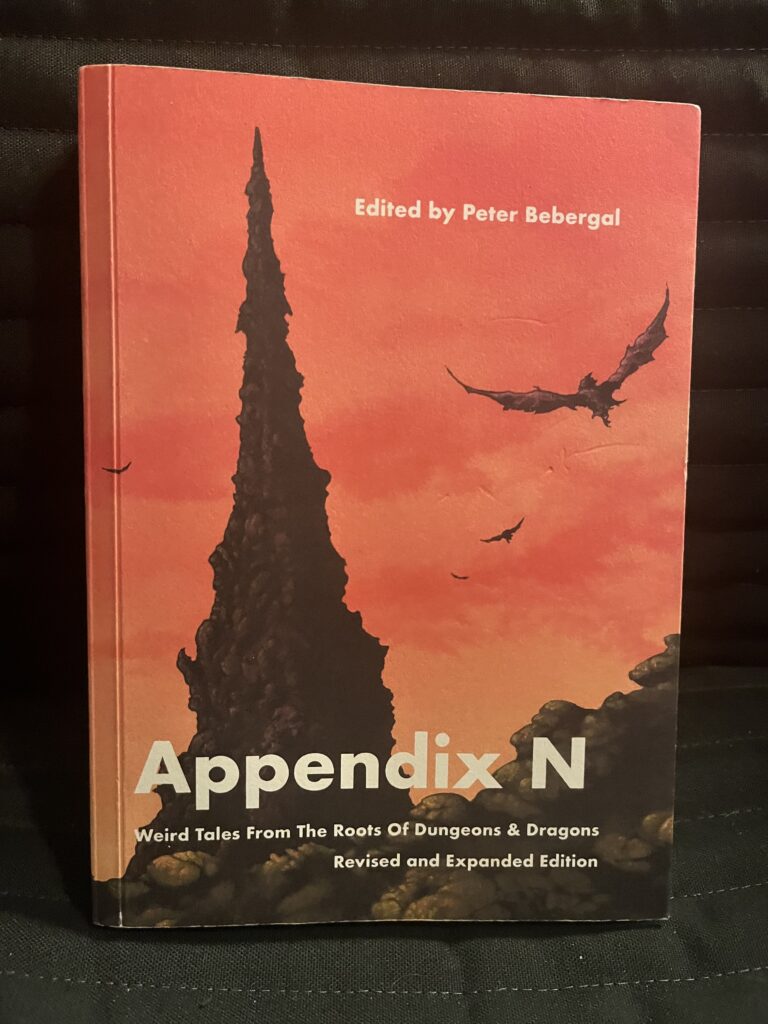
    Appendix N: Weird Tales From the Roots of Dungeons & Dragons, edited by Peter Bebergal

    I’m firmly of the opinion that it’s impossible to understand any genre or medium if you don’t have a good knowledge of its history. So many fantasy writers and gamemasters don’t seem to realize that the genre has roots that go further and deeper than Tolkien, and so much of that history can make for excellent inspiration for enthralling stories and games. This collection of curated tales from the famous “Appendix N” at the end of the original Players Handbook provides a wide overview of some of the writers whose influence on gaming is often overlooked: Lord Dunsany, Robert Howard, Michael Moorcock, C.E. Moore, and so many others. It’s especially enjoyable to be able to dip into a wholly unique fantasy world for just a short story. Short fiction set in secondary world fantasy settings is rare these days (although some markets, like Beneath Ceaseless Skies, provide an excellent home for those stories), so being able to experience new settings and characters without having to commit to a whole seven-volume trilogy is a nice treat. 

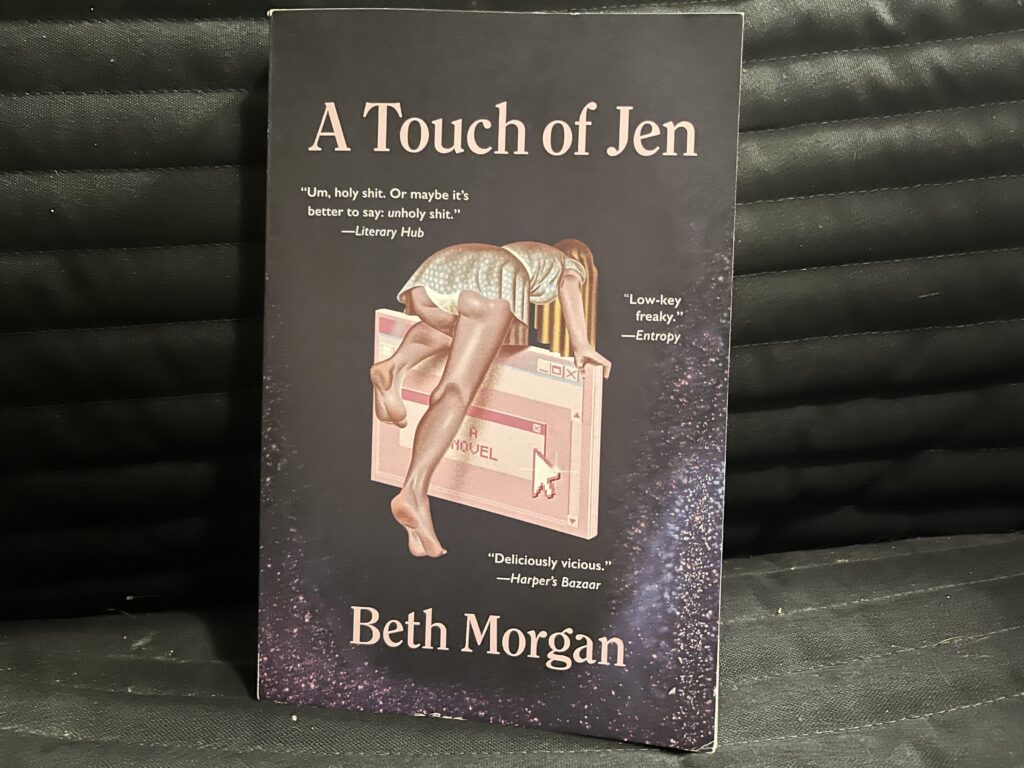
    A Touch of Jen, Beth Morgan

    I love stories about horrible people failing in entertaining, catastrophic ways. Not many people can say that It’s Always Sunny in Philadelphia is one of their comfort watches, but I’m a weirdo in that sense, I suppose. Keep that in mind when I tell you that the characters in A Touch of Jen are some of the most compellingly terrible weirdos I’ve encountered in a long time. This book is absolutely unhinged in the best way. It follows the story of a millennial couple who are both obsessed with one of their former coworkers, a globetrotting jewelry designer and influencer whose every Instagram post they devour. When the object of their obsession invites them on a surfing trip, it sets off a series of cascading incidents that destabilize the lives of every person in their orbit. I won’t spoil the directions that this book goes, largely because I was surprised by them as well. Let’s just say that it takes a lot to catch me off guard in a narrative, and A Touch of Jen did so about five or six times. 

    Comfort stories are a bit of a theme in today’s post, eh? I suppose that makes some sense. It’s the Fourth Quarter Holiday, after all, a time of cozying up with a blanket and a book, with a cat on top of you and a beverage of your choice at your side. I’ve got one more post planned in the next few days, about my favorite music that was released this year. Hope you’ll stick around to read it! I promise one of the albums is not metal, at least not entirely. 

    ~ Ian (listening to GLORY by Teen Jesus and the Jean Teasers)

  • Books I’m Enjoying, November 2025

    Books continue to exist, and therefore I’m buying and reading them. While a lot of my reading comes from the Seattle Public Library, I’m always down to support local bookstores. Around where I live, I recommend Elliott Bay Book Company, Third Place Books, and Kinokuniya (not a local store technically, but still one of my favorites for manga series and works in translation). Here’s a selection of what I’m enjoying now:

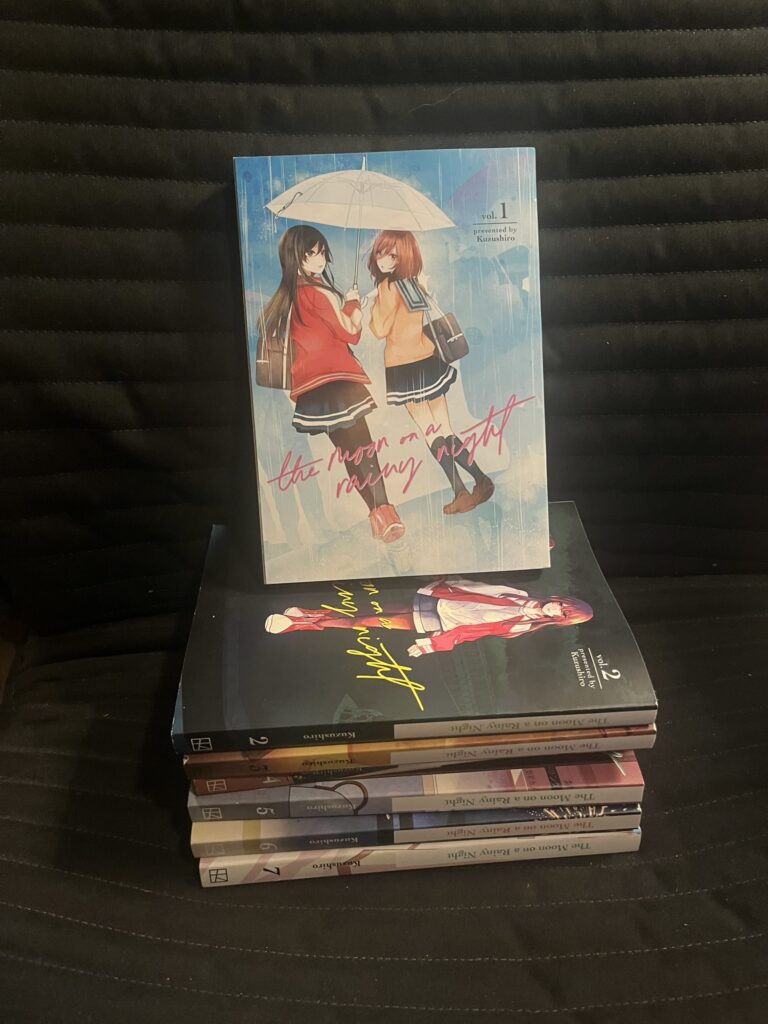
    Kuzushiro, The Moon on a Rainy Night

    I have the softest of spots for chaste, slow-burn yuri manga, and The Moon on a Rainy Night hits me right in the sweet spot (so much yearning!). But the real reason that I love this manga so much, and why I immediately purchase a new volume when I spot it on the shelves, is because one of the characters is Deaf. While former piano prodigy Kanon still has some hearing in one ear, she needs a hearing aid to be able to go to school and interact with the world. Her disability has isolated her, and it’s only when the bubbly Saki shows up in her life that she’s able to connect with friends her own age. As someone who deals with an invisible disability every day, I was astonished at how well Kuzushiro portrays the social aspects of disability. The responses that Kanon gets from fellow students in her class – “she’s only doing it for attention”, “she just wants special treatment”, “everyone lets her get away with everything”, “she’d be a lot better if she actually tried” – are exactly the sorts of comments that people in my adolescence, even into my adult life, so they hit particularly hard. I’m just hoping that these crazy kids can kiss soon, because it’s been seven volumes. I mean, I like a slow burn, but does it have to be this slow?

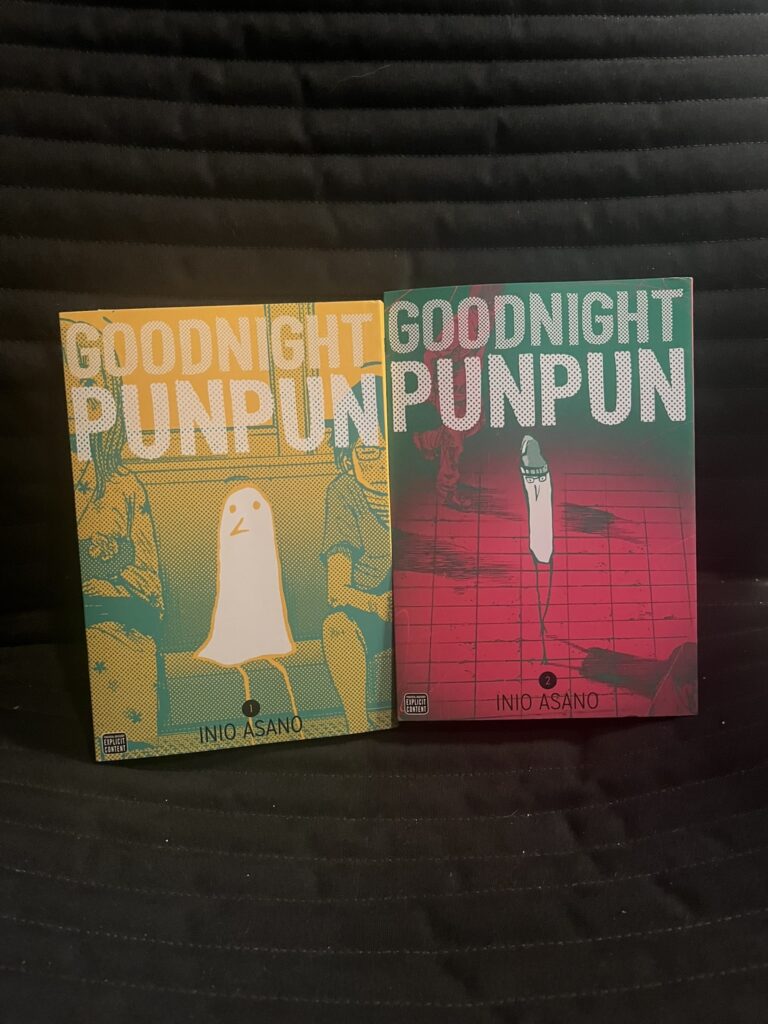
    Inio Asano, Goodnight Punpun

    I was familiar with Asano’s work from his haunting adolescent romance manga A Girl on the Shore, and after spotting this series at Kinokuniya, I decided to pick it up. It deals with a lot of the same subjects as A Girl on the Shore – the isolation of young people in disastrous family situations – but with a darkly comedic twist. I always enjoy stories that can go from laugh-out-loud funny to deeply emotionally affecting. I also love Asano’s art, which ranges from hyper-realistic backgrounds of run-down Japanese suburbs to the cartoony abstraction of the main character Punpun. Also, in case you’re wondering, at no point does anyone comment on the fact that Punpun is a bird.

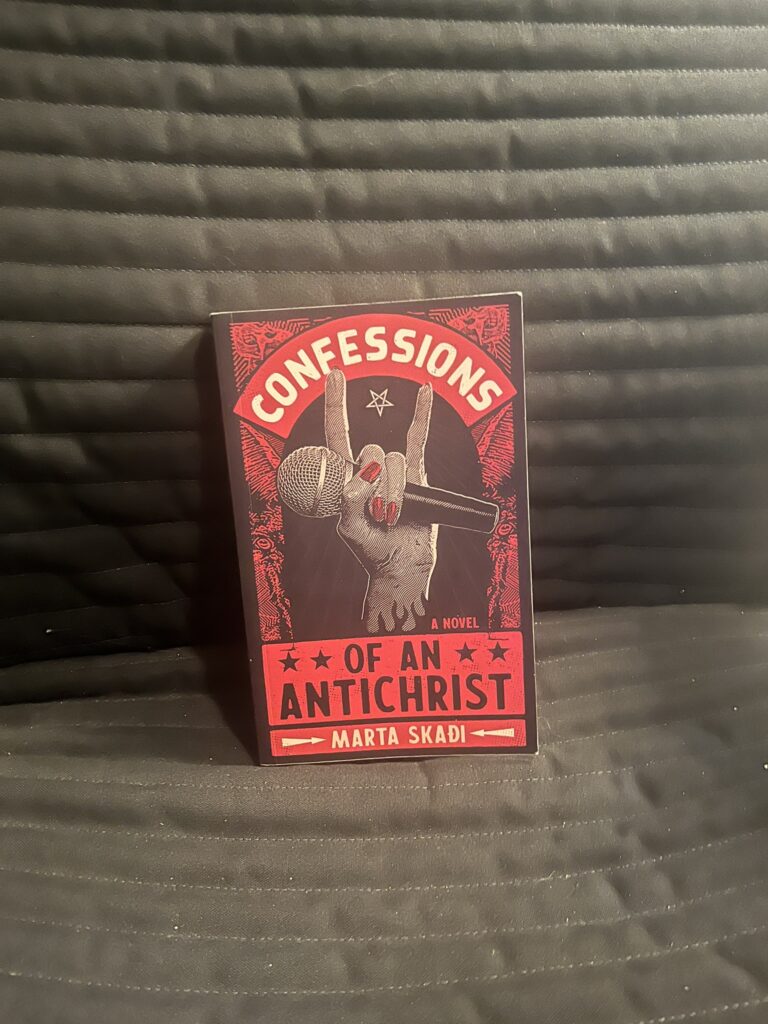
    Marta Skaði, Confessions of an Antichrist

    More teenage outcasts in blackly comedic situations, although in this case they’re members of a black metal band with a lead singer who may legitimately be the Antichrist. I know for a fact that I would love second-wave Norwegian black metal, but every time I consider listening to Mayhem or Burzum, I remember Varg Vikernes’s politics and recoil in horror. (There’s a fair amount of black metal that I do enjoy, but anything from that scene is not my jam). The members of Baphomet’s Agony spend more time beating up fascists and religious bigots with comically oversized dildos, though, so that’s more in line with my overall worldview. And Confessions of an Antichrist contains enough sex, Satanism, and metal to make my withered, blackened heart grow several sizes. There’s even a touch of romantic angst. Apparently my choices in reading lately have a theme…

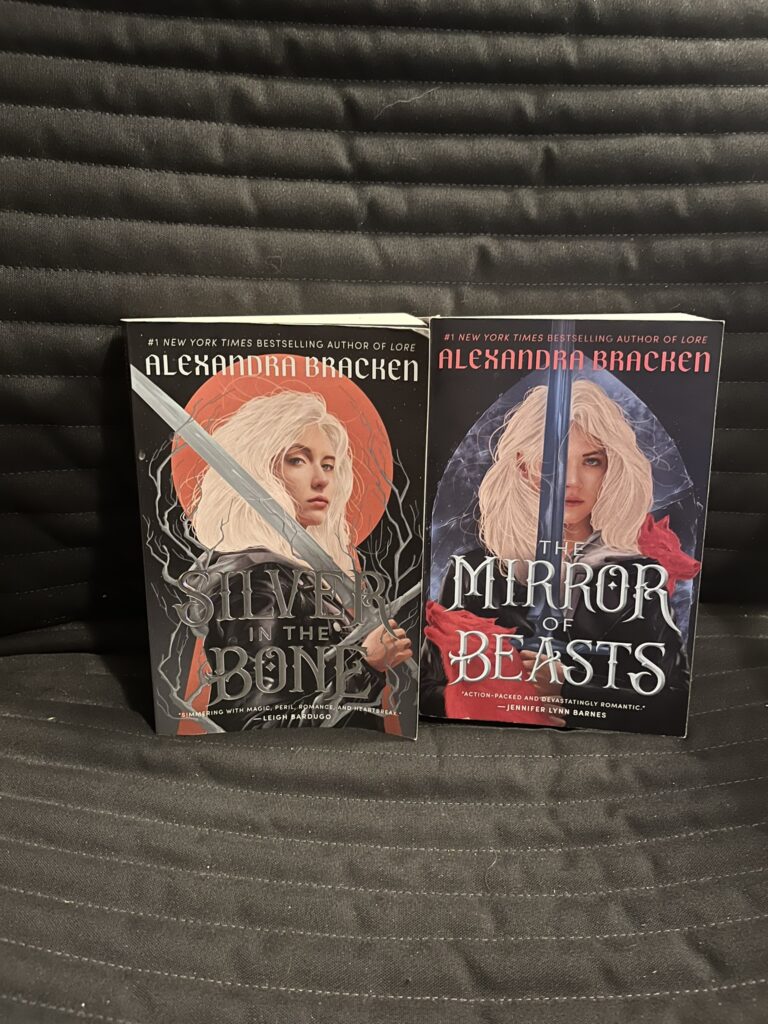
    Alexandra Bracken, Silver in the Bone and The Mirror of Beasts

    Speaking of tormented teenage romantic longing, this duology has that in spades. I had a lot of fun with the main character Tamsin’s banter with her rival-turned-lover Emrys over the course of these books, as well as the Arthurian and Welsh mythology that underpins the setting of the book. I love seeing Welsh myth brought into the modern era – it’s far less utilized than Irish legend – as you’ll see if/when my New Adult urban fantasy novel comes out. Maybe it’s time for me to reread the Prydain Chronicles again so I can scratch that itch…

  • Books I’m Enjoying, October 2025

    People like me keep on writing books, and the publishing industry still views fiction as a profitable enterprise (for now), so there’s an inexhaustible supply of reading material for us all. The amount of new stories means that I can literally never run out of books in my lifetime. Still, I’m the sort of person who rereads books. If there’s a story I enjoy, I love experiencing it again. Sometimes this exercise is nostalgic, like the comfort of coming home. Or, like Bilbo coming back to the Shire in The Hobbit, I come back to an old favorite to learn that I’m the one who has changed. 

    Currently, I’m rereading the entirety of the Elric series by Michael Moorcock, in the gorgeous Saga Press hardcover omnibuses that got put out a few years back. It’s perhaps impossible to exaggerate how important the Elric books were to me as an impressionable teenager. The saga of a sorcerous emperor, slayer of his kin and marked as an outcast by the fact of his albinism, utterly dependent on his demonic sword and controlled by a doomed destiny… let’s just say that the character was like crack for an angsty young man with Very Big Feelings™. I wasn’t alone. The Elric stories, and Moorcock’s work more generally, were so influential to sixty years of writers that it’s sometimes hard to tell in hindsight just how influential they were. I feel like they’re like the Amber books by Roger Zelazny in that regard. There are plenty of similarities between the Elric and Amber stories as well: the multiversal travel and the somewhat ironic tone is part of the appeal of both. 

    Someday I might want to do a series of blog posts about rereading the Elric books, like the reread blogs that Jo Walton had collected in Why This Book Is So Great. I’ve got a lot of plans for this website in general, though, so it might take a little while before I get to those. 

    At the same time, since I can never read just one book at once, I’ve been reading a lot of Haruki Murakami as well. I started by plowing through the entirety of 1Q84 over the course of a visit my best friend in Boston (another reread book that I hadn’t dipped into in over a decade), then picking up Novelist as a Vocation at the Kinokuniya in the International District, along with other works like Killing Commendatore, After Dark, and the short stories in First Person Singular. I really enjoyed the essays in Novelist as a Vocation, by the way. 

    I especially liked the story about how Murakami decided to become a writer. He was at a baseball game at Meiji Jingu Stadium in Tokyo, at the Yakult Swallows’ season opener. The leadoff batter in the bottom of the first hit a double into left field, and as it dropped, Murakami suddenly thought, I think I can write a novel. That night, he stopped at a bookstore in Shinjuku on the way home and bought a pad of notebook paper and a ¥2000 fountain pen, and over the course of the rest of the baseball season, he sat at his kitchen table and wrote Hear the Wind Sing

    That’s the secret. It really isn’t complicated to write a novel. You don’t need an MFA or divine inspiration or anything like that. You need an idea, the persistence to work consistently, and something to write on. It’s that simple, and that hard, at the same time.

    Going back to the fantasy genre, I recently read R.R. Virdi’s The First Binding and really enjoyed it. I would basically pitch it as a South Asian Name of the Wind. And when I say it’s like Name of the Wind, I mean it’s really like Name of the Wind. It has a frame story, a talented, determined underdog hero, and more than that, many of the plot details follow Rothfuss’s work to the degree that it can’t be up to coincidence. 

    Still, even with all these parallels, I had a lot of fun with The First Binding. Talking of further blog posts, I want to write something about how originality in fiction is a vastly overrated virtue. The ability to come up with original ideas is far less valuable than being able to tell a story convincingly and compellingly. Besides, Shakespeare only came up with one original plot in his life, and people don’t talk shit about Shakespeare being unoriginal, do they? 

    Anyway, that’s a sampling of what books have been in my backpack in the last few weeks. Anyone else enjoying some stories? Anything you’d recommend? 

    ~ Ian (listening to Cartoon Darkness by Amyl and the Sniffers)