Tag: incredibly deep thoughts

  • light a roman candle and hold it in your hand

    It’s July 4 here in America. Well, technically it’s July 4 everywhere, except on the other side of the International Date Line, where I suppose it’s tomorrow. This is America’s Independence Day, and more than that, it’s the 250th anniversary of America’s independence. This is a big deal! As far as I can count, there are eight countries (Czechia, Slovakia, Bosnia and Herzegovina, Timor-Leste, Serbia, Montenegro, Kosovo, and South Sudan) that are younger than I am, so lasting this long is something to be celebrated. 

    And yet, due to the Way Things Do Be™, I’m left with more complicated feelings about this anniversary than celebratory ones. A lot of those have to do with the rotting pumpkin man currently occupying the White House. But more than that, it’s about the hijacking of patriotism and even the definition of what it is to be American by billionaires, religious extremists, and bigots of all kinds. As usual, I’ll try to get my thoughts in order by writing them, and I’ll end by saying why I think it’s important to celebrate Fourth of July despite these assholes. 

    When we define a “country”, we’re really talking about three separate things: the people, the current government, and the land itself. Those can become difficult to tear apart for some people, especially since the government supposedly flows from the wishes of the people, but there is a difference between, say, an Iranian person and the Islamic Republic of Iran. Iran is a land rich in culture and tradition, a culture that rivaled Rome at its height, which brought us Persepolis and the Behistun inscription, algebra and the 1001 Nights. I have a great respect for that culture and the people who came from it. I do not have respect for the Islamic Republic, which is a theocratic fascist regime, nor do I have respect for the Shah’s rule that preceded it. I hope that someday a government comes to Iran that reflects that country’s heritage, the wisdom and gifts that it has given the world. 

    Similarly, I can love the people of Israel while categorically rejecting the Zionist project, fight for Palestinians’ right to self-determination without supporting Hamas’ terrorist attacks. One of the most important lessons about the internet is that, most often, the assholes aren’t the majority, even though it seems that way. It’s just that they’re the ones who can scream the loudest – and often, those loud screamers end up in positions of power. 

    Which brings me to my country. In terms of land, America is unparalleled anywhere in the world. What other country has tropical rainforests and arctic glaciers, alligator-filled swamps and mountains that practically scrape the sky? And what other country has cities like New York or Chicago or Seattle, places where people from all around the world can mix, creating new foods, new art forms, entire ways of thinking? We’re the country that created New York pizza and the Mission burrito, hip-hop and rock and jazz, the animated cartoon and the video game. 

    We can do this because “American” isn’t an ethnic identity like “Norwegian” and “Japanese”, because we don’t have thousands of years of history and tradition weighing us down. Because of this, anyone can be an American, and we can all look to the future. 

    That’s what I believe. But there are millions of people – not the majority, but a significant amount of very loud assholes – who reject that idea. They’ve created a restrictive version of America that doesn’t include the masses, that only includes them and the people who look and act and believe like them. They’re trying to force this definition on the whole country, forcing us to get in line with their view or be destroyed. And they just so happen to have elected the loudest, stupidest asshole in the whole world to be their figurehead. 

    These people have hijacked the symbols of patriotism like the flag and the national anthem so that now, in order for people to show that they do not stand with the loud assholes, they are forced to reject those symbols. And by rejecting those symbols, the assholes claim that we hate America. The ironic fact is that these assholes, who paint themselves to be so patriotic, actually do hate America. Or rather, they hate Americans: millions of us, brown and gay and trans and disabled, anyone who does not conform to their narrow, exclusionary vision of what it is to be American. 

    Well, guess what, fuckers. We don’t have to conform to your vision to be American. We reject your small-minded vision of what this country should be. Because America has never been a white Christian English-speaking nation. (Just look up the Treaty of Tripoli for proof of that fact.) And even if it were, we have the right to choose our own path. We have the right to reject the atrocities committed by the past and create a new future where your toxic beliefs remain in the sewer where they belong. 

    I’m not advocating blind patriotism. America has done and continues to do horrendous things, and many of those crimes are still unanswered for. But loving a friend or a family member doesn’t mean loving them only when they do the right thing. It means accepting their flaws while also holding them accountable. One of the most patriotic things we as Americans can do is demand that our government should be better. If you see a friend or a family member hurting themselves, either unwittingly or knowingly, you help them. And America is hurting itself. Stepping in to stop that – to make it and ourselves better – is the most patriotic thing you can do. 

    People don’t protest because they hate America. They protest because that is one of the most profound expressions of love anyone can give: to recognize something is wrong and stepping in to fix it. That’s what true patriotism is about, not blind obeisance to a pedophile rapist dementia-riddled nepo baby snowflake who’s turned the executive branch into his own personal racketeering operation. 

    The assholes have claimed the symbols of patriotism because they see themselves as the only true Americans. The most powerful rebuke of that attitude is not to reject or denigrate those symbols but to appropriate them for ourselves. They do not get to say that only they get to wave the American flag or celebrate the Fourth of July. They do not get to say that only they are the real Americans. They do not get that right just because they say so. They claimed it for themselves, and we can take it back. 

    So, for America’s 250th anniversary, this disabled, queer, progressive, autistic, asexual, democratic socialist, atheist, long-haired, Satanic t-shirt-wearing American citizen is going to be doing exactly that. 

    And eating hot dogs. 

    Because hot dogs. 

    ~ Ian (listening to When the Kite String Pops by Acid Bath)
  • the men that don’t fit in

    I wanted to show my dad some of the poetry of Robert Service, a.k.a. “the Bard of the Yukon”, because his poems so often celebrate the beauty of the solitary life in the wilderness. I downloaded a copy of The Spell of the Yukon and Other Verses from gutenberg.org, and after reading through the poems again, I was struck by one particular verse. It’s called “The Men That Don’t Fit In”, and I’ll reproduce it below, because the poem’s in the public domain and no one can stop me.

    “There’s a race of men that don’t fit in,
    A race that can’t stay still;
    So they break the hearts of kith and kin,
    And they roam the world at will.
    They range the field and they rove the flood,
    And they climb the mountain’s crest;
    Theirs is the curse of the gypsy blood,
    And they don’t know how to rest.

    If they just went straight they might go far;
    They are strong and brave and true;
    But they’re always tired of the things that are,
    And they want the strange and new.
    They say: “Could I find my proper groove,
    What a deep mark I would make!”
    So they chop and change, and each fresh move
    Is only a fresh mistake.

    And each forgets, as he strips and runs
    With a brilliant, fitful pace,
    It’s the steady, quiet, plodding ones
    Who win in the lifelong race.
    And each forgets that his youth has fled,
    Forgets that his prime is past,
    Till he stands one day, with a hope that’s dead,
    In the glare of the truth at last.

    He has failed, he has failed; he has missed his chance;
    He has just done things by half.
    Life’s been “a jolly good joke on him,
    And now is the time to laugh.
    Ha, ha! He is one of the Legion Lost;
    He was never meant to win;
    He’s a rolling stone, and it’s bred in the bone;
    He’s a man who won’t fit in.”

    I wonder how many of the gold miners in the Klondike (and in California, and in Australia, and in every gold rush there was in history) were neurodivergent. They definitely weren’t people who had happy, stable, settled lives. In the days of the Oregon Trail, about one out of every ten pioneers died on the trip to the Northwest. The reward, when they reached the end, was to be cut off from all their family and friends back East, possibly for a lifetime, while they scrabbled in a wilderness devoid of material comforts, far from the madding crowd.

    What would make a person choose to leave all of that behind and go on a trip that they would never return from, that carried a ten percent mortality rate? I expect that the reason was that the slim prospect of something in Oregon was much better than what they had back East. Many of them, probably, didn’t have to worry about leaving friends and family behind because they had no friends and family. They didn’t leave jobs and housing and a stable life because they didn’t have those things. They left, in short, because they had nothing to lose.

    I resonate with those people, and with the men that Service wrote about. I’ve struggled to find work for my whole adult life, lost friendships because of the other person’s intolerance and rigidity. And I think that if I wrote stories that were more commercial, more in line with what the publishing world wants, I would be published by now.

    But my brain doesn’t work like that. That statement isn’t a humblebrag, by the way. So much of my life, my childhood training, my neuroses, are about pretending to be “normal”, whatever the standard definition of “normal” is, and falling short. It’s not that I don’t try. It’s that a “normal” brain is as alien to me as my brain is to the average neurotypical.

    How many people like me have there been throughout history? Sure, some of them struck it rich, but how many of them died alone in the wilderness, lost to history, just a pile of weathered broken bones? How many of them would have survived if their brains had worked in a different way?

    It makes me wonder. I don’t know the answer. All I know is that if it weren’t for the men and women who don’t fit in, neurotypicals would be lost without us.

    ~ Ian (listening to the soundtrack for Where the Water Tastes Like Wine by Ryan Ike)

  • thoughts on being average

    Thought the First

    If we trace the Semitic languages as far back as we can, we can find out that the Proto-Semitic word for blindness was something like *ʕwr. This eventually got extended to mean “damage someone’s eye to make them blind”, and eventually, when it arrived in Arabic as ‘awār, meaning “damage” more generally.

    By the time *ʕwr became ‘awār, the Arabs were no longer desert nomads. This was the Islamic golden age, and ships of Arab sailors plowed the Mediterranean, trading with nations across Africa, Asia, and Europe. The Venetians and Genoese were especially close trading partners with the Arabs. They borrowed the word ‘awār as avaria, which, due to the maritime links with the Arabs, meant “damage to a ship’s cargo”.

    The word got borrowed into many different European languages, usually meaning something like “damage”. The word averría in Spanish, for example, means a mechanical failure in a car. But in English, after a detour through French as the word avarie and the addition of the suffix -age to bring it in line with words like damage, this word passed into maritime law as a method of determining the shared liability of cargo damaged or lost at sea. This financial liability would be apportioned by adding up the value of all damaged goods and dividing by the number of interested parties.

    By the 1600s, that word got used to refer more generally to taking the arithmetic mean in general, then, in the 1800s, to mean “typical” or “ordinary”, then, finally, to mean “unexceptional” or “middling in quality”. And that’s how we get the word average.

    From blindness to boring in five thousand years.

    Thought the Second

    Half of all people have two testicles. Half of all people have none.

    Half of all people have two ovaries. Half of all people have none.

    This means, mathematically speaking, the average person has one testicle and one ovary.

    Thought the Third

    Some people lose fingers or toes. Some people have their ears cut off. Some people have one or both eyes put out. Some people have their arms torn off or their limbs amputated.

    I have ten fingers, ten toes, two ears, two eyes, two arms, and two legs.

    I think, technically, that makes me above average.

  • various thoughts and thinkings, february 2026

    I continue to not be writing very much, at least writing that’s intended to be published in any real form. I don’t know if I’m supposed to feel guilty or not because of that. I assume I shouldn’t, because I don’t feel guilty, but it still feels weird. When I’m in the swing of things, I usually write about a thousand words a day. This doesn’t feel that impressive to me. When I was a teacher in Madrid, I mentioned to one of my fellow auxiliares, a grad student from Swansea in Wales, that every day after school got out, I went to a cafe and wrote 2000 words. He was astonished. “How long does that take you?” he sputtered.

    I was confused. “Like, maybe an hour and a half?”

    “It would take me five hours to write that much! How are you so fast?”

    I shrugged. “Autism.”

    It sounds flippant, but it’s not. My brain’s ability to hyperfixate means that, when I get into the groove of something (especially something I’m interested in), I can block out the entire world and hone in on just that one thing for effectively indefinitely. There are drawbacks, but honestly, considering how they are in so many other ways, it’s surprising to me that neurotypicals can be productive writers. I mean, how can you be productive on a book if you’re spending all your time dating or having a family or a career or such other unnecessary fripperies?

    Still, aside from minor touch-ups on a few short fiction pieces, I haven’t written anything meant for publication in weeks. I was talking with a friend before our biweekly D&D session, however, and she said something that was more profound than I think she realized. “It’s okay to have a fallow period every once in a while,” she told me. I immediately thought, Fallow. What a great metaphor. As I’m sure all history nerds know, in a crop rotation system, a fallow field is hardly unproductive. Rather, it’s a critical part of replenishing the soil with nitrogen so that the field can be even more fertile the next season. Especially if you graze livestock in that fallow field so you can get still have some productivity out of that field that year. I just have to let the goats of daily experience poop in my brain so that my mind-field is re-nitrogenated, thus allowing much more fertile story-crops.

    Does this metaphor make sense? I think this metaphor makes sense.

    In any case, just because my story-field is currently fallow doesn’t mean that I haven’t been creative. Rather, I’ve rotated into writing lore and backstory for my D&D campaign. This is pleasant because there’s not much pressure to perform. My players are some of my best friends. I know that, no matter what, they will be a receptive audience, even if agents and short story markets might not be. Besides, writers love coming up with lore. I can think of several fantasy series that I’m sure primarily exist so the author can tell you all the neat lore they’ve come up with. It certainly can’t be because of the characters or the plots, because they’re not good or interesting. Ideally, I want the lore in my stories to be a side element. But that doesn’t mean that I don’t enjoy making it, and this gives me an excuse.

    Also! I had a conversation with an editor I met at DragonCon this last summer. He’d given me his business card, so I figured that it would be cool to reach out, and he was very kind in letting me ask him questions about the publishing industry and the way it be. Specifically, I wanted to know why, for the last few years, I’ve found it very difficult to get agents to request full manuscripts, when in the past I actually had agents reaching out for more writing rather frequently. He said that it’s not just me. Because of how everything generally is, sales are down across the publishing industry, and as such, agents are far less willing to take chances on unknown writers, especially if the writing defies easy categorization. The most important thing, he said, is to do the same thing that I’m already doing: keep writing, keep revising, keep querying. The number one thing that separates successful from unsuccessful writers is the same as it ever was: sheer, bloody-minded, pig-headed determination.

    At the very least, I can at least rest easy that, as always, there’s nothing wrong with me. It’s capitalism’s fault!

  • oft evil will doth evil mar

    I haven’t been updating this blog lately. There’s a very simple reason why: I haven’t been writing lately. I’ve been utterly overwhelmed with everything that’s been going on in the world lately, and especially here in the United States. I know that my country hasn’t always been the shining beacon of goodness and democracy that it has claimed to be, but I do think that overall, America has tried to do the right thing for the world, even when that has been misguided or just plain wrong. To see the events in Minneapolis recently, alongside the threat of a pointless war with Europe and the crumbling of eighty years of the post World War II world order, has been almost more than I can handle. Everything sucks these days, and for all the last month, I haven’t been able to work on anything except in the most desultory manner.

    But in times of trouble, like many people, I take comfort in my holy book. For me, that is probably Lord of the Rings.

    Yeah, it’s a cliche to say that I encountered Lord of the Rings and The Hobbit and had my entire personality and worldview changed. I’m not the only one. Be glad that it was Tolkien that triggered my writing obsession, not Robert Heinlein or Ayn Rand.

    If there are any lessons to be taken from Lord of the Rings, it’s that anyone, even the smallest among us, has the ability to change the world, and that no one, not even the most wretched among us, is beyond “pity”, as Tolkien put it, or empathy, as I would more likely phrase it. But that’s not what gives me comfort in this moment. No, it’s the chapter where the Isengard orcs kidnap Merry and Pippin in order to, as the meme says, “take the hobbits to Isengard”.

    The reason why Merry and Pippin are able to escape the orcs isn’t because they overpower them with strength of arms. It’s because the orcs kill each other. The orcs are composed of three different groups striving for dominance: the warrior Uruk-Hai, the orcs of Mordor, and the goblins of the Misty Mountains. The squabbling and posturing between them eventually leads to a massacre, because that’s what always happens among evil people. They will always destroy each other through the force of their own hatred and stupidity.

    The only way you can get evil people to work on a unified goal is when someone even stronger and more evil forces them to submit to their will. And, fortunately, the man who is the eye of the storm of darkness consuming my country is not strong. He is a fat, demented slug of a man, a lazy narcissistic coastal elite who, for some reason, has managed to grift millions into thinking he’s a working-class hero, with no interests or desires aside from satisfying his own vanity and enriching himself. And you just have to look at him – the softness in his body, the deadness in his eyes – to know that he’s not long for this world. Once he’s gone, who do you think can wield the kind of strength and cruelty that can keep his minions in line? J.D. Vance? Kristi Noem? Stephen Miller?

    For people who claim to be Christians, the current government clearly hasn’t learned the gospels’ warning re: houses built on foundations of sand. Only in this case, they’ve built their empire on a foundation of fat, saggy flesh, piloted by a brain that is just a couple Filet-O-Fishes away from a hemorrhage so powerful it could kill God. The greatest enemy of evil is evil.

    I’ll finish with the following quote by Tolkien himself, from “On Fairy Stories”:

    In what the misusers of Escape are fond of calling Real Life, escape is evidently as a rule practical, and may even be heroic. In real life it is difficult to blame it, unless it fails; in criticism it would seem to be the worse the better it succeeds […] Why should a man be scorned if, finding himself in prison, he tries to get out and go home? Or if, when he cannot do so, he thinks and talks about other topics than jailers and prison-walls? The world outside has not become less real because the prisoner cannot see it. In using Escape in this way the critics have chosen the wrong word, and what is more, they are confusing, not always by sincere error, the Escape of the Prisoner with the Flight of the Deserter. Just so a Party-spokesman might have labeled departure from the Führer’s and any other Reich and even criticism of it as treachery […] Not only do they confound the escape of the prisoner with the flight of the deserter, but they would seem to prefer the acquiescence of the ‘quisling’ to the resistance of the patriot. To such thinking you have only to say ‘the land you loved is doomed’ to excuse any treachery, indeed to glorify it.

    It is our duty to resist. It is our duty to love. It is our duty to dream of other, better worlds, no matter how many orcs or balrogs or Nazgûl stand against us.

    Besides, all things are temporary. This will end. We will remain.

    ~ Ian (listening to the soundtrack to O Brother, Where Art Thou?)

  • finished with my woman cause she couldn’t help me with my mind

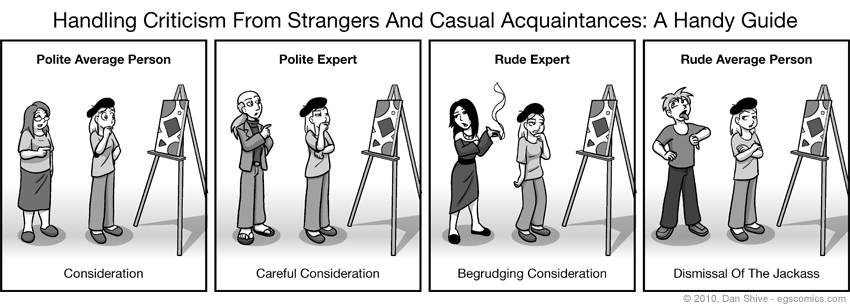
    I got some criticism from a reader recently that I’m having trouble getting out of my head. I don’t need to go into the details about who the reader was or what the criticism is. It’s just something that stuck in my head, making me question a lot of things about my writing. And even if I’ve talked with other beta readers who’ve told me, some in emphatic terms, that they disagreed with this reader’s particular analysis, it was still something that I’m hyperfixating on, probably to the detriment of my work.

    I know I shouldn’t do this. I don’t know why I put the opinions of someone who doesn’t like my work over the opinions of people who do. I wish that I could kick this paranoia, but it’s hard. If I get too in my head, however, I try to take the advice of this old Dan Shive comic:

    It’s a good idea in theory, but at the same time, hard to put into practice. Having a moderate anxiety disorder means that my paranoia can take over everything I do and lead me to question everything. Of course, I make up for the anxiety with bouts of self-loathing depression. Such is the life of a writer, I suppose.

    Yesterday, I got so pissed off at a novel in progress that I decided to completely change the antagonist and the main character’s backstory. This, of course, is not a small change, and it’s frustrating. If revising a novel is like renovating a house, then I expected to patch some holes in the drywall and repair some faulty plumbing, and instead I have to tear the house down to the foundation and replace the entire roof. This work in progress is one of my favorite things I’ve done, and I love writing scenes with the characters, but ultimately I estimate that I’ll have to completely rewrite about 40% of the book, not to mention revising most of the existing scenes to make it so that everything is consistent.

    I should trust in myself, I know. I’m a good writer, and I’ve had multiple publishing professionals tell me that. I can fix what’s wrong with the story. At the same time, though, I’m angry at myself – even though first drafts aren’t supposed to be perfect, even if the road to a finished product is never easy. Even if the twists and turns I’ve taken on this story have been like pulling teeth.

    Speaking of pulling teeth, I’m going to the dentist tomorrow to get most of the teeth on the upper left side of my mouth fixed. This involves multiple crowns, fillings, possibly root canals – and even that may not solve everything. So my generalized anxiety right now is understandable, I suppose. I’ve learned that autistic people tend to mask when we’re in discomfort or pain, because so often our discomfort is dismissed or minimized. This leads to minor medical problems eventually becoming severe, costing thousands of dollars. At least I have insurance now from my new job, so the bill will be in the three figures rather than the four or five.

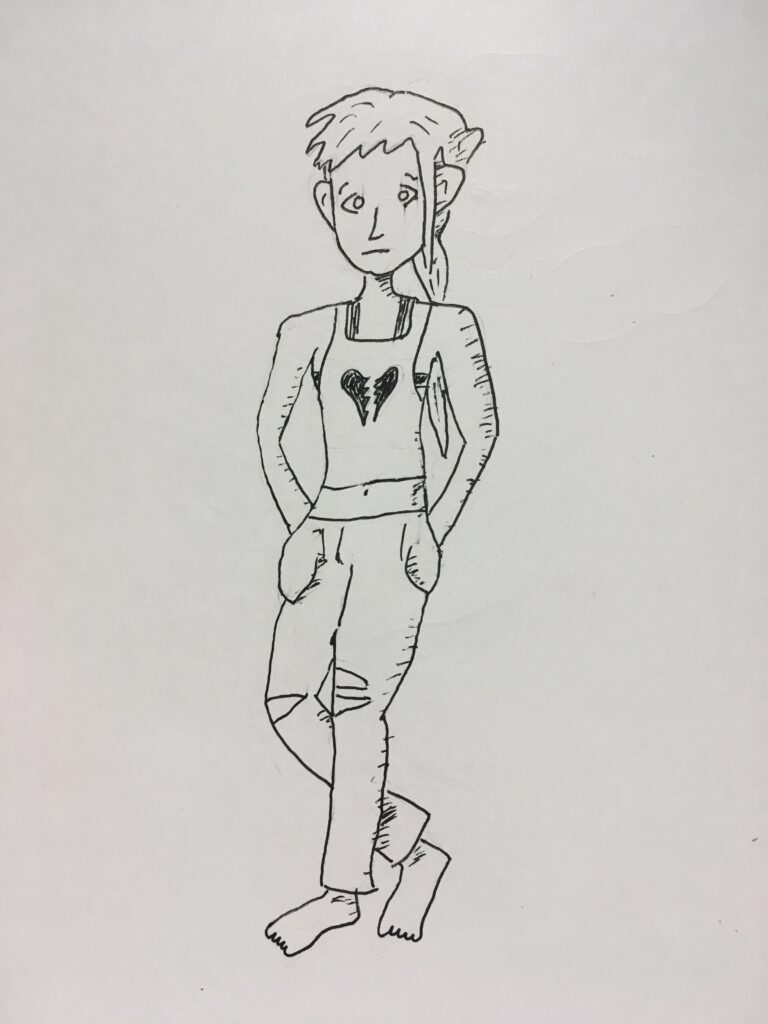
    This has been a bit of a bummer of a blog post, I guess, so I’ll finish it with a drawing I did several years ago. It’s the main character of a very long, complicated writing project that I hope to complete one day. Her name is Sophie. I’m excited for you to know her story.

    ~ Ian (listening to Pogo Rodeo by Psychedelic Porn Crumpets)

  • in the wake of adversity

    credit: Jabin Botsford

    When I was just a little guy, a baby-faced twenty-year-old with a downy chin and a lingering adolescent acne problem, I couldn’t imagine ever getting a rejection for my writing. Why would I? As discussed in one of my previous posts, I thought I was hot shit.

    Now, after almost seven hundred rejection letters, I can really imagine getting rejected.

    I’m not unique in this, I know. It’s frustrating because I know I’m a good writer. Am I a great writer? Probably not. But I have an ear for dialogue, an eye for description, an ability to create complex and compelling characters, and more importantly than anything, an unutterably stubborn, pig-headed determination. But even I’m not great, I can take a lesson from those who are not only great, but who are transcendent: the kinds of talents that come along once in a century, if not more.

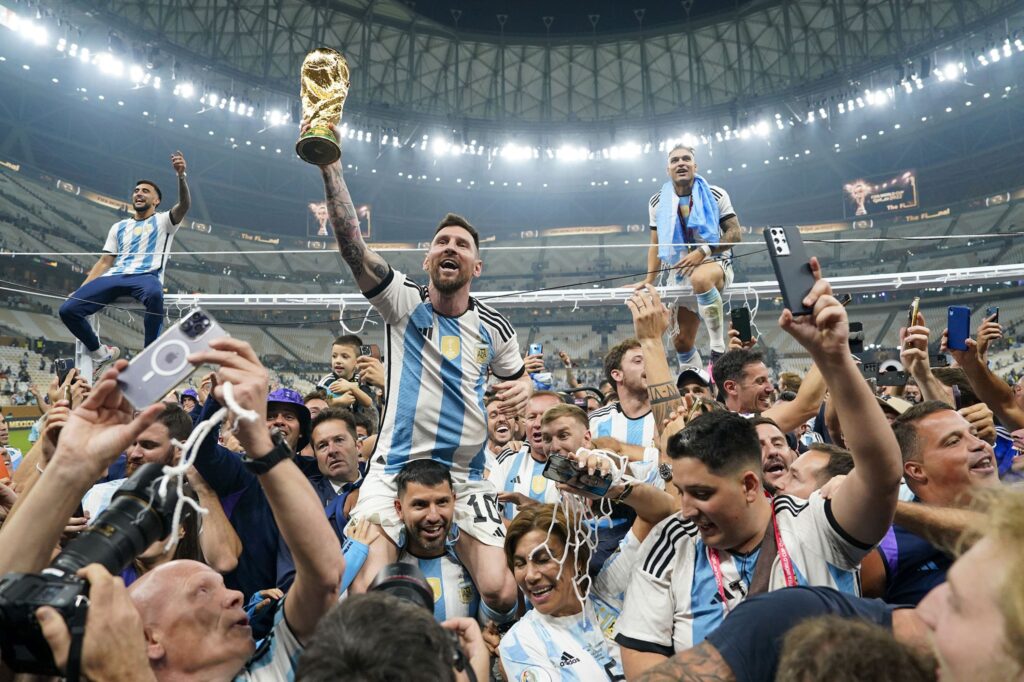
    Case in point: Lionel Messi.

    By any reasonable statistic, Messi is the greatest footballer of the twenty-first century. The only people who even come close to his level across history are Pele and Maradona. Maybe you can include Christine Sinclair, if you want to add women’s footballers. But even though he’s possessed of a left foot blessed by the golden gods, it wasn’t as if everything came easy for him. When he was a boy on the mean streets of Rosario, Argentina, he was head and shoulders above all the other kids in the Newell’s Old Boys academy in all ways except height. In fact, he was released from the academy because the club couldn’t afford the hormone treatments that would allow him to grow to anything approaching a normal height. Fortunately for Messi, FC Barcelona stepped in, said “We will pay for your growth hormones, tiny child,” and took him to Spain to play for their academy, La Masia, which is basically the equivalent of Soccer Harvard.

    Messi advanced through the ranks and broke into the first team, and he and Barcelona started dominating. League titles, Copas del Rey, Champions Leagues… there was nothing that the Barcelona of the 2000s and the 2010s didn’t win. And yet, while Catalunya loved him, the people in Argentina thought that he was barely even Argentine. He had grown up in Spain, they claimed. He wasn’t a “man of the people”, whatever that means. Whatever their justification, the people of Argentina were cool, if not overtly hostile, to him.

    Fast forward to Qatar in 2022. Messi no longer plays for Barcelona. He’s well into the last stages of his career. 2022 might be his last chance to win a World Cup. Fortunately, after winning the Copa America last year, the Argentine public has warmed to Messi. His fellow players will run through a wall for him. If Messi wants to win a World Cup with Argentina, this might be his last chance…

    …and they lose the first game to Saudi Arabia.

    It seems inevitable in hindsight, when really it was anything but. They got out of the group stage, fought tooth and nail through the knockout rounds, and got to the final against France. Even then, Argentina had to overcome over two hours of football (two regular halves and two extra-time periods), a Kylian Mbappé hat trick, and a pants-shittingly tense penalty shootout before claiming the world title after the greatest final in World Cup history.

    I remember that final. I was in a pizzeria in Madrid when I watched it. Most of the people working there were Argentine. You’d think the roof would’ve come off that place when the final penalty went in.

    I’m not the Messi of writing. I’m not even close. But if someone who has a legitimate shout to be the greatest of all time in his particular field still had to go through the wringer to achieve his destiny, maybe none of us should feel bad for going through adversity to achieve ours.

    Even if it kind of sucks.