Tag: originality

  • talk to me like humans do

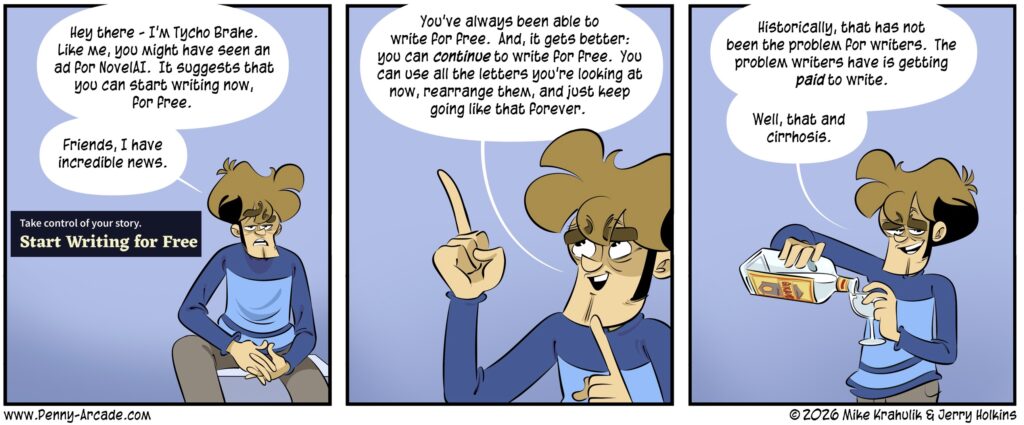
    My friend and fellow Resnick Award nominee Jason Boyd sent me this Penny Arcade comic from a few days ago:
    Screenshot

    That last panel… woof.

    (As a side note, I’ve actually met Jerry Holkins in person. I think that if you spend enough time in tabletop gaming stores in Seattle he will just make himself manifest. As I recall, he was buying Age of Sigmar figurines.)

    Aside from the perils posed by the other issue discussed in that last panel (I speak as someone who has, on occasion, consumed a wee bit too much of humanity’s favorite recreational hydrocarbon), there’s a lot to be said about the act of “creation” under AI that I still have a lot of thoughts about. As far as I can tell, the proponents of AI-based “writing” tools seem to have this belief that the reason writers write is to have a salable produce at the end of it – that the point of writing is to have written. In this worldview, books and stories are entirely fungible, and the act of creation is a burdensome chore. Think of how much time you’ll have, they imply, now that the boring writing part is out of the way!

    I think that, all things considered, if I had more time to write, I would probably spend that time writing.

    Perhaps I should view this narrow, ultracapitalist view of artists and creation as sad, or reprehensible. But I mostly find it confusing. For people who make tools that are ostensibly intended to help artists, I wonder if these tech bro AI proponents have actually ever interacted with an artist in any meaningful way. Or, perhaps, do they only socialize with other brogrammers in their spare time, and their worldview is so warped by that tiny echo chamber?

    This is largely the same reason why I don’t argue with fundamentalist Christians. Not because I think that they’re right, but because it would be impossible. The parameters by which our worldviews operate are so fundamentally different that communication couldn’t exist between us. In order for a discourse to occur, there has to be some kind of consensual reality that we can use as a basis. Otherwise, it would be like trying to discuss which pizza topping is best, only to learn halfway through an increasingly heated argument that when your interlocutor says pizza, they mean small cherrywood box filled with decorative painted thimbles from the Scandinavian region. There is an inherent incompatibility that becomes impossible to overcome.

    If you see nothing fundamentally different between a book written by a human and a hundred thousand words of Markov-chain generated text, maybe AI writing tools are a good idea to you. I suppose they both contain letters and words, and can be held in a .doc file. But if that’s the case, then you must genuinely believe that there is no difference between a human and a Markov-chain computer program, and when you’ve reached that point, our universal parameters are so contradictory that communication between us is impossible.

    ~ Ian (listening to Spine by Myrkur)

  • random sketchery, november 2025

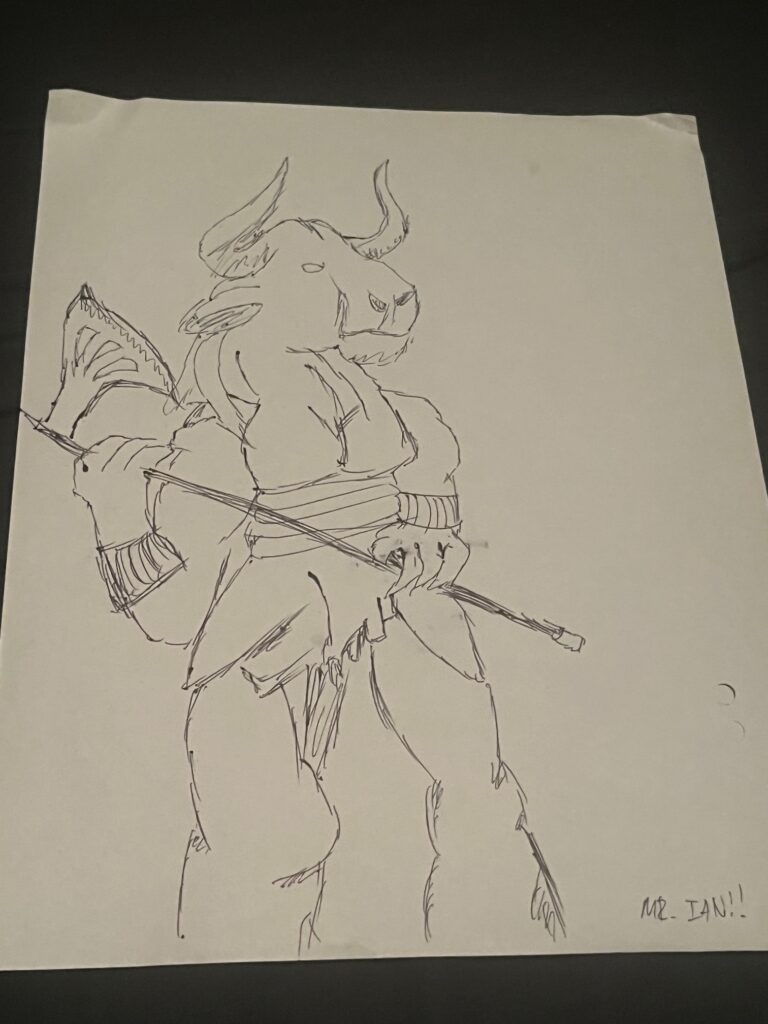
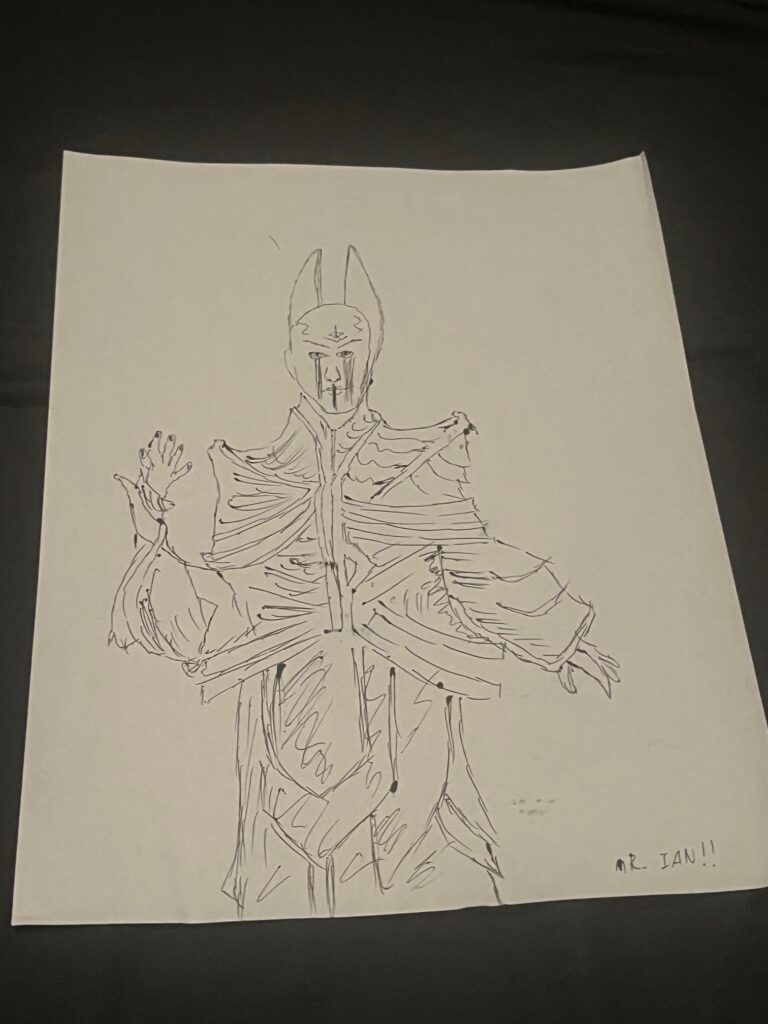
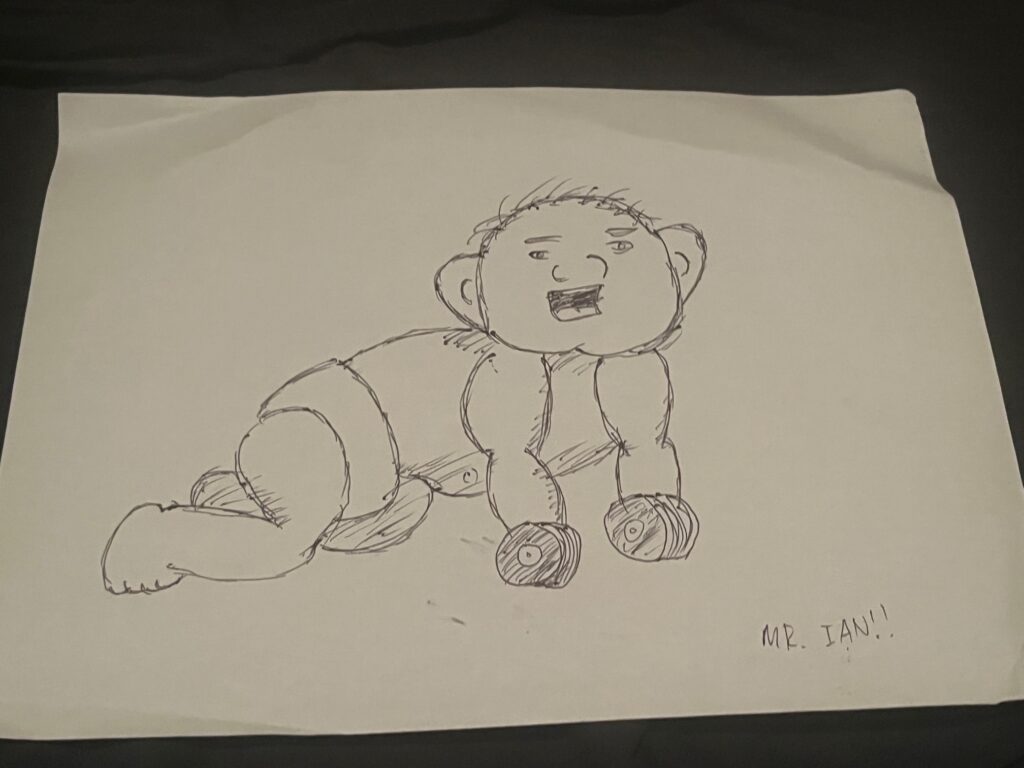
    Since I’ve started my new job working with kids at an after-school program, I’ve had to find some way to impress or entertain them. Fortunately, I’m sort of a competent artist. At the very least, a lot of the kids think that I’m amazing, and drawings from Mr. Ian have become coveted commodities – so coveted, in fact, that I’ve had to institute a limit of one drawing per kid per day in order to actually be able to, you know, do my job. At the request of my cousin Stephen, an award-winning illustrator who enjoyed the drawing on the About page, I decided to share some of my recent random sketches.

    Most of the drawings come from the 5e Monster Manual, which I bring to class as reference material, and in order to instill a proper sense of geekiness within my young charges. These drawings use the art in that book as reference, and were drawings that I chose to make for myself. Drawing from photographic or artistic reference is a great way to practice, and it’s a good thing I have the Monster Manual in front of me, because I couldn’t do nearly as nice work without something to guide me.

    Mind Flayer:

    Minotaur:

    Human Fighter:

    Archmage:

    And finally, as a non-D&D related piece of art, a baby with two wheels instead of hands, in tribute to the beautiful minds of Sirs Thomas Cardy and Brian David Gilbert:

    As an aside, I’ve noticed that there’s a certain segment of commenters online who say that drawing using reference material is a crutch, that it’s at best lazy and at worst an act of plagiarism. I find this completely baffling. Not only have artists used references for literally thousands of years (unless you think that those Renaissance masters came up with the subjects of their portraits and still-lives entirely out of their imaginations), but how do you think you’ll be able to draw what something looks like if you don’t actually, well, look at it? I shouldn’t let comments like that annoy me too much, though. Probably the people who say things like that aren’t actual artists and have never made anything in their lives. Either that or they’re bots farming engagement. What a time to be on the internet…

  • Books I’m Enjoying, October 2025

    People like me keep on writing books, and the publishing industry still views fiction as a profitable enterprise (for now), so there’s an inexhaustible supply of reading material for us all. The amount of new stories means that I can literally never run out of books in my lifetime. Still, I’m the sort of person who rereads books. If there’s a story I enjoy, I love experiencing it again. Sometimes this exercise is nostalgic, like the comfort of coming home. Or, like Bilbo coming back to the Shire in The Hobbit, I come back to an old favorite to learn that I’m the one who has changed. 

    Currently, I’m rereading the entirety of the Elric series by Michael Moorcock, in the gorgeous Saga Press hardcover omnibuses that got put out a few years back. It’s perhaps impossible to exaggerate how important the Elric books were to me as an impressionable teenager. The saga of a sorcerous emperor, slayer of his kin and marked as an outcast by the fact of his albinism, utterly dependent on his demonic sword and controlled by a doomed destiny… let’s just say that the character was like crack for an angsty young man with Very Big Feelings™. I wasn’t alone. The Elric stories, and Moorcock’s work more generally, were so influential to sixty years of writers that it’s sometimes hard to tell in hindsight just how influential they were. I feel like they’re like the Amber books by Roger Zelazny in that regard. There are plenty of similarities between the Elric and Amber stories as well: the multiversal travel and the somewhat ironic tone is part of the appeal of both. 

    Someday I might want to do a series of blog posts about rereading the Elric books, like the reread blogs that Jo Walton had collected in Why This Book Is So Great. I’ve got a lot of plans for this website in general, though, so it might take a little while before I get to those. 

    At the same time, since I can never read just one book at once, I’ve been reading a lot of Haruki Murakami as well. I started by plowing through the entirety of 1Q84 over the course of a visit my best friend in Boston (another reread book that I hadn’t dipped into in over a decade), then picking up Novelist as a Vocation at the Kinokuniya in the International District, along with other works like Killing Commendatore, After Dark, and the short stories in First Person Singular. I really enjoyed the essays in Novelist as a Vocation, by the way. 

    I especially liked the story about how Murakami decided to become a writer. He was at a baseball game at Meiji Jingu Stadium in Tokyo, at the Yakult Swallows’ season opener. The leadoff batter in the bottom of the first hit a double into left field, and as it dropped, Murakami suddenly thought, I think I can write a novel. That night, he stopped at a bookstore in Shinjuku on the way home and bought a pad of notebook paper and a ¥2000 fountain pen, and over the course of the rest of the baseball season, he sat at his kitchen table and wrote Hear the Wind Sing

    That’s the secret. It really isn’t complicated to write a novel. You don’t need an MFA or divine inspiration or anything like that. You need an idea, the persistence to work consistently, and something to write on. It’s that simple, and that hard, at the same time.

    Going back to the fantasy genre, I recently read R.R. Virdi’s The First Binding and really enjoyed it. I would basically pitch it as a South Asian Name of the Wind. And when I say it’s like Name of the Wind, I mean it’s really like Name of the Wind. It has a frame story, a talented, determined underdog hero, and more than that, many of the plot details follow Rothfuss’s work to the degree that it can’t be up to coincidence. 

    Still, even with all these parallels, I had a lot of fun with The First Binding. Talking of further blog posts, I want to write something about how originality in fiction is a vastly overrated virtue. The ability to come up with original ideas is far less valuable than being able to tell a story convincingly and compellingly. Besides, Shakespeare only came up with one original plot in his life, and people don’t talk shit about Shakespeare being unoriginal, do they? 

    Anyway, that’s a sampling of what books have been in my backpack in the last few weeks. Anyone else enjoying some stories? Anything you’d recommend? 

    ~ Ian (listening to Cartoon Darkness by Amyl and the Sniffers)