Tag: “poetry”

  • the men that don’t fit in

    I wanted to show my dad some of the poetry of Robert Service, a.k.a. “the Bard of the Yukon”, because his poems so often celebrate the beauty of the solitary life in the wilderness. I downloaded a copy of The Spell of the Yukon and Other Verses from gutenberg.org, and after reading through the poems again, I was struck by one particular verse. It’s called “The Men That Don’t Fit In”, and I’ll reproduce it below, because the poem’s in the public domain and no one can stop me.

    “There’s a race of men that don’t fit in,
    A race that can’t stay still;
    So they break the hearts of kith and kin,
    And they roam the world at will.
    They range the field and they rove the flood,
    And they climb the mountain’s crest;
    Theirs is the curse of the gypsy blood,
    And they don’t know how to rest.

    If they just went straight they might go far;
    They are strong and brave and true;
    But they’re always tired of the things that are,
    And they want the strange and new.
    They say: “Could I find my proper groove,
    What a deep mark I would make!”
    So they chop and change, and each fresh move
    Is only a fresh mistake.

    And each forgets, as he strips and runs
    With a brilliant, fitful pace,
    It’s the steady, quiet, plodding ones
    Who win in the lifelong race.
    And each forgets that his youth has fled,
    Forgets that his prime is past,
    Till he stands one day, with a hope that’s dead,
    In the glare of the truth at last.

    He has failed, he has failed; he has missed his chance;
    He has just done things by half.
    Life’s been “a jolly good joke on him,
    And now is the time to laugh.
    Ha, ha! He is one of the Legion Lost;
    He was never meant to win;
    He’s a rolling stone, and it’s bred in the bone;
    He’s a man who won’t fit in.”

    I wonder how many of the gold miners in the Klondike (and in California, and in Australia, and in every gold rush there was in history) were neurodivergent. They definitely weren’t people who had happy, stable, settled lives. In the days of the Oregon Trail, about one out of every ten pioneers died on the trip to the Northwest. The reward, when they reached the end, was to be cut off from all their family and friends back East, possibly for a lifetime, while they scrabbled in a wilderness devoid of material comforts, far from the madding crowd.

    What would make a person choose to leave all of that behind and go on a trip that they would never return from, that carried a ten percent mortality rate? I expect that the reason was that the slim prospect of something in Oregon was much better than what they had back East. Many of them, probably, didn’t have to worry about leaving friends and family behind because they had no friends and family. They didn’t leave jobs and housing and a stable life because they didn’t have those things. They left, in short, because they had nothing to lose.

    I resonate with those people, and with the men that Service wrote about. I’ve struggled to find work for my whole adult life, lost friendships because of the other person’s intolerance and rigidity. And I think that if I wrote stories that were more commercial, more in line with what the publishing world wants, I would be published by now.

    But my brain doesn’t work like that. That statement isn’t a humblebrag, by the way. So much of my life, my childhood training, my neuroses, are about pretending to be “normal”, whatever the standard definition of “normal” is, and falling short. It’s not that I don’t try. It’s that a “normal” brain is as alien to me as my brain is to the average neurotypical.

    How many people like me have there been throughout history? Sure, some of them struck it rich, but how many of them died alone in the wilderness, lost to history, just a pile of weathered broken bones? How many of them would have survived if their brains had worked in a different way?

    It makes me wonder. I don’t know the answer. All I know is that if it weren’t for the men and women who don’t fit in, neurotypicals would be lost without us.

    ~ Ian (listening to the soundtrack for Where the Water Tastes Like Wine by Ryan Ike)
  • ians crismal pome

    On Crismal thyme, the Jesus birthed

    Oll in a winders ‘daey.

    Butt mayblor summer also was

    I couldnot rilly say.

    No room they was in inn that knight,

    No pillor sopht and deep,

    But onlie straws and ketchup packs

    In maingor for to speep.

    And angles fly in sheepy fields,

    A three or five or more,

    A sign cosign hypotenoose,

    They roar a mihgthy roar.

    And then the Jeesis give him gifts,

    The merry wizzards three,

    Merlin, Bugs, and Dumbledore,

    T’wuz such a sihgt to see.

    For all Free Peebles Middle-earth,

    The Elfs, the Dworbs, the Men,

    And Hobbits sing they lickle songs

    In they disgusting den.

    So that the crismal story was,

    And now I howpe you seeee,

    I read me strory from a book,

    And I’m only sixty-three.

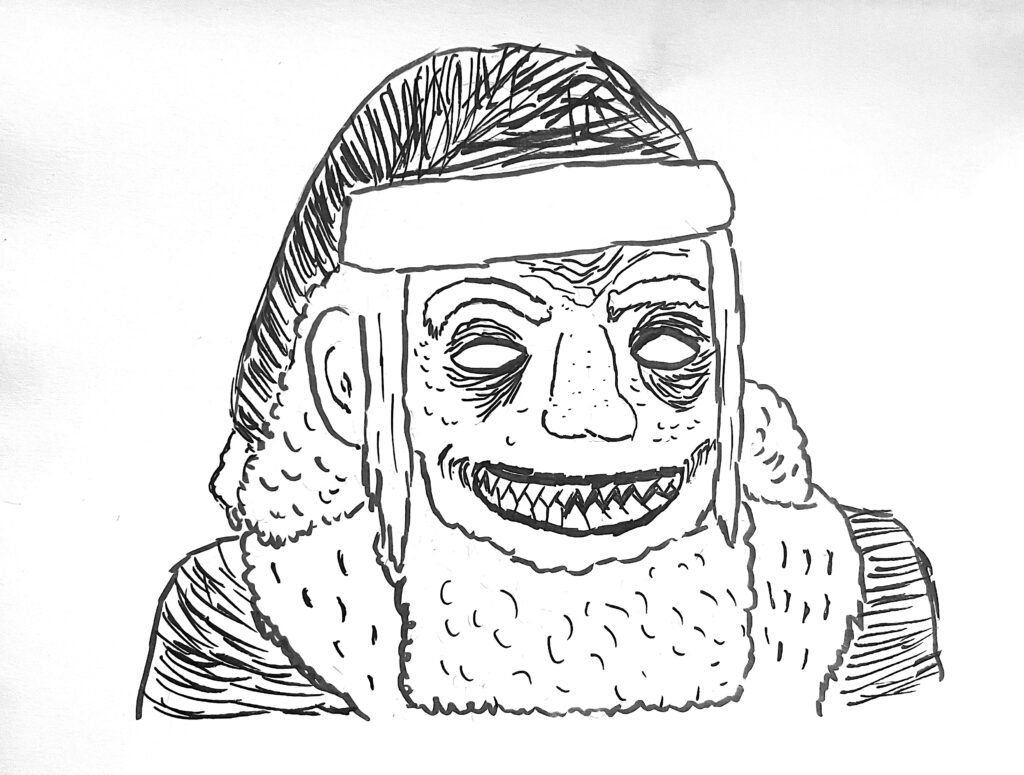
  • A Visit From The Winter King…

    ‘Twas the night of the Solstice, and all through the world

    Not a creature was stirring, not even a squirrel. 

    The traps were all set by the chimney with fear,

    For we knew that the Winter King soon would be here. 

    The children were huddled, too frightened to sleep,

    They shivered and shuddered and made not a peep. 

    Mom had her katana, and I had my bat, 

    And there, back-to-back, in our bedroom we sat. 

    When out on the lawn there arose such a screaming,

    I though that a nightmare I surely was dreaming. 

    Away to the window I ran like a terrier, 

    I threw back the curtains and peeped through the barrier. 

    The moon on the breast of the new-fallen snow

    Gave a pallor like corpse-flesh to objects below. 

    When what, to my horrified eyes should arise

    But eight dire wolves that came down from the skies,

    They all pulled a chariot, a terrible thing, 

    And the being that drove it was the Winter King. 

    Like red-taloned bloodhawks his canids did land

    And he shouted their names, a whip in his hand: 

    “Now Mangler, now Strangler, now Icemaw, now Hoary,” 

    On, Ripper, on, Reaver, on, Gnawer and Gory!

    To the top of the porch, to the top of the wall,

    Now dash away, dash away, dash away all!” 

    As damn’d souls that from the black hellmouth do sail, 

    As they rise from the earth with a piteous wail, 

    So up to the rooftop his horrors they flew, 

    With the grim Winter King, and the chariot too,

    And then, as I listened, a sound gave me pause, 

    The clicking and tapping of thirty-two paws. 

    As I let out a moan, while I soiled my drawers, 

    The Winter King’s feet beat like drums on the floor. 

    He was dressed all in skins, and they reeked and they stank, 

    And his clothes were all bloody and slimy and rank. 

    A sack full of heads was flung on his back, 

    And he smiled at me, his lips and teeth black. 

    His eyes, how they glistened! His knuckles so hairy! 

    His cheekbones so haggard, his feet were so scary! 

    His hideous maw was encircled with slime, 

    And the footprints behind him were puddles of grime. 

    He gave me a leer, with his inky-black teeth, 

    And the stink of his breath circled him like a wreath. 

    He was withered and gaunt, a hideous beast, 

    And I gibbered and wailed, since my life soon would cease. 

    A wink of his eye and a twist of his head

    Turned my insides to jelly and filled me with dread. 

    He spoke not a word, but went straight to his task, 

    And killed my whole family, but saved me for last. 

    And using a cleaver to cut out my bowels, 

    He slipped up the chimney, as quiet as owls. 

    He leapt on his chariot, to his pack gave a holler, 

    And they went to the heavens where no man shall follow. 

    Then as I lay dying, I heard the King cry, 

    “Happy Solstice to all! NOW YOU’RE ALL GONNA DIE!”