May is nearly over, but that’s no excuse not to do a Books I’m Enjoying post! It’s hard to believe that it’s almost summer and that 2026 is nearly half over. At the same time, with all the ongoing goings-on, it feels like it’s been 2026 for almost a decade. At least, I felt like I’ve aged a decade in that time.
That being said, books continue to come out and remain great, so let’s get into some of them!
Destroy All Humans, They Can’t Be Regenerated by Katsura Ise and Takuma Yokota
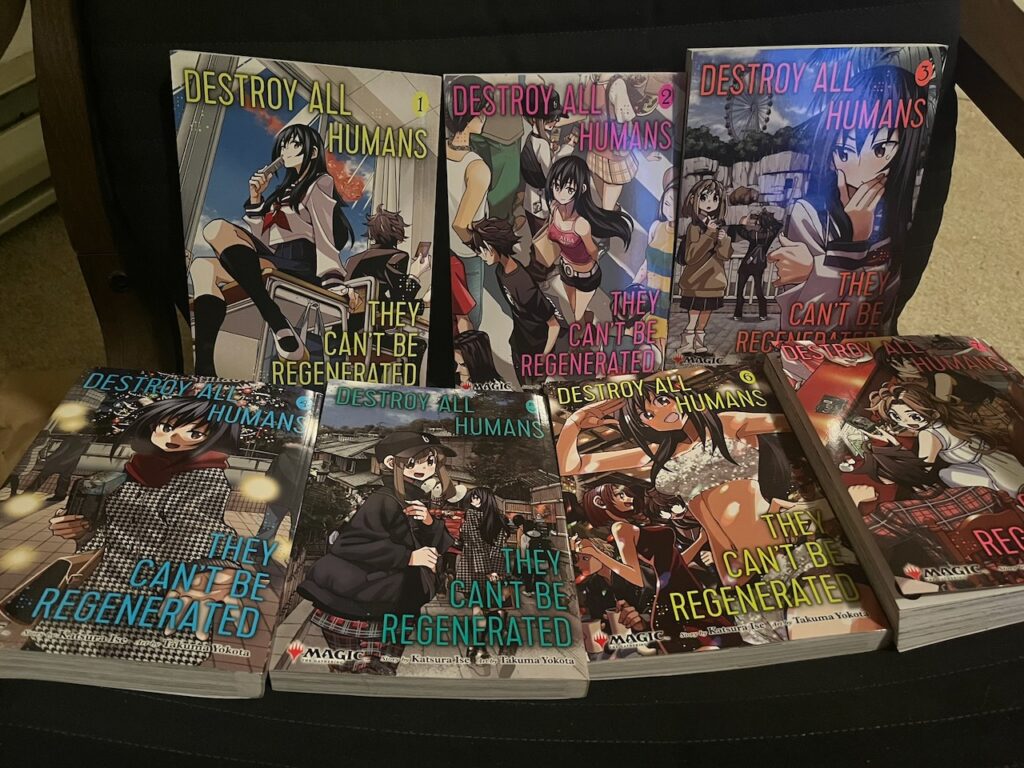
When I was in elementary school, I got really into Magic: The Gathering, as many people do. I credit MtG for introducing me to algebra, at least when I realized that the X in mana costs didn’t mean ten. And while I don’t play Magic frequently these days (the onslaught of Universes Beyond slop has really turned me off the game), every few years my love of the game returns, like some childhood virus that lingers in my system, occasionally flaring into a disgusting Magic rash. Does this mean that Magic is like shingles? I don’t know. This metaphor makes sense in my head.
Anyway, this manga brings back all the nostalgia for that time for me, at least the good aspects of elementary school. Set in 1998, the main characters, Emi and Hajime, are middle schoolers obsessed with Magic who form a friendship despite being academic and social rivals. The art is cute and winsome, and the scenes between the MCs toe the line between funny and heartfelt, often on the same page. I love the rivals-to-friends-to-lovers story arc that Emi and Hajime are going down, and it’s great to see a manga with genuine appreciation for the game and the connections that it makes. I’d be curious, however, if the scenes with card games make any sense to non-Magic players. I understand what’s going on in them because I understand the rules and strategies, but would a normie?
Daemons of the Shadow Realm by Hiromu Arakawa
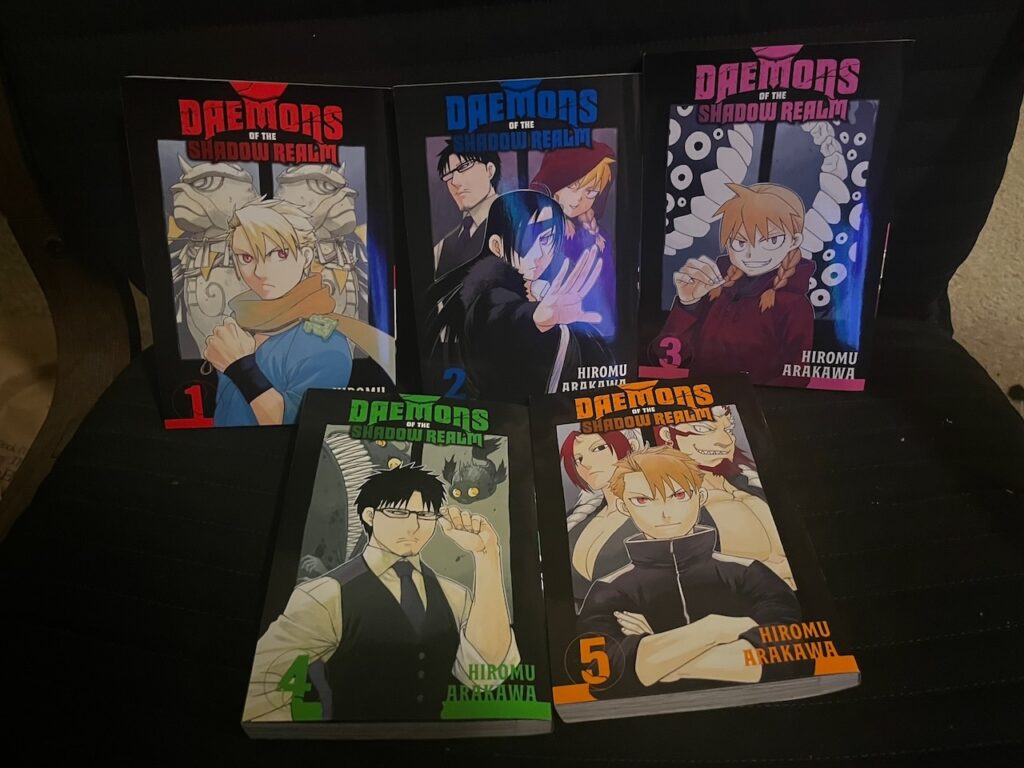
Hiromu Arakawa is a manga legend. She created Fullmetal Alchemist, which so many otaku consider to be one of the greatest manga and anime of all time, and if she just retired after FMA to bask on her laurels, I would understand. But in recent years, she’s created a new series about two siblings, Yuru and Asa, raised in a hidden mountain village that comes under attack from the modern world, and who command paired daemons. Daemons of the Shadow Realm has all the shonen action and compelling magic that characterizes FMA, set in an alternate modern-day Japan. Fans of the Elric brothers will not be disappointed! (I think? It feels weird to talk about books as if I’m writing a review column for Kirkus, but maybe that’s what this is? Ah well. Es lo que hay.)
Beyond the Clouds: The Girl Who Fell From The Sky by Nicke
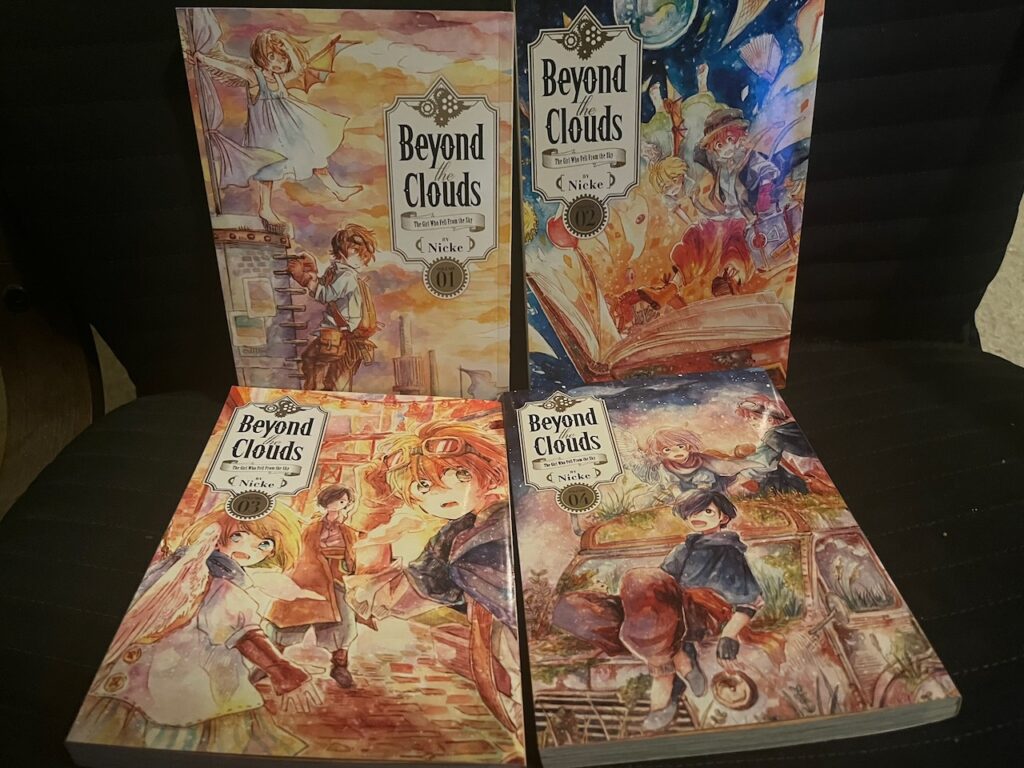
I swear I’ve been reading more than just manga lately! This series, however, is something special. It’s about a ten-year-old winged girl named Mia who falls from the sky, then awakens in an industrial city called Yellow Town with no memory and no ability to get back to the sky. Fortunately, an engineer boy named Theo constructs a mechanical wing for her. But when she starts manifesting bizarre magic powers, they leave Yellow Town on a quest to learn how to control Mia’s magic. Nicke’s art is lush and appealing, her steampunk-inspired setting feels so real you could jump into it, and the adopted sibling relationship between main characters Theo and Mia gives all of the feels. If you like early Ghibli films like Laputa and Nausicäa of the Valley of the Wind, this should hit you just right. I assume.
(By the way, interesting fact, in Spanish, Laputa was renamed to Lapita, because la puta means something obscene. Being bilingual is fun!)
Gormenghast Trilogy by Mervyn Peake
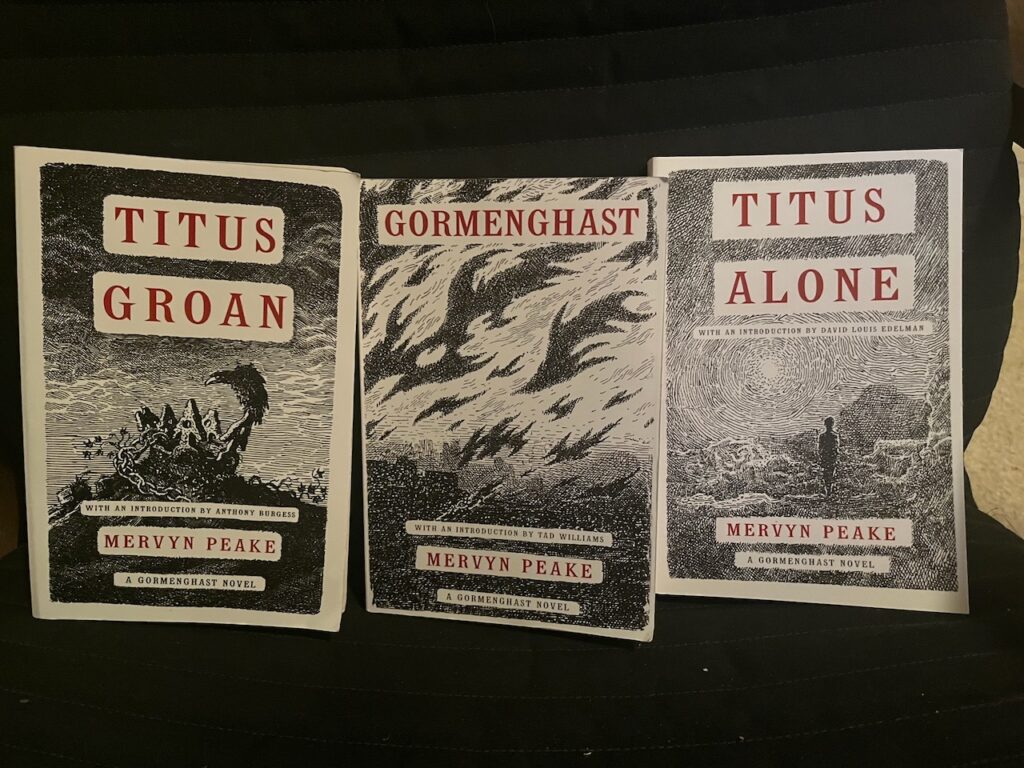
See? I can read books without pictures in them – although Mervyn Peake was, in addition to being a transformative writer, an illustrator of great talent. His black-and-white line drawings accompany the text, and they are just as haunting and unsettling as the words, putting Peake in a category with other dark fantasy authors/illustrators like Clive Barker and Brom.
The Gormenghast books are difficult to describe. They lie at the boundary between fantasy, gothic horror, and surrealism. Ostensibly, they’re about Titus Groan, seventy-seventh Earl of the castle of Gormenghast, but at the same time the series is about Gormenghast, with the motley cast of characters (wicked Steerpike, doomed Fuschia, darkly comic Doctor Prunesquallor and his spinster sister Irma, among many others) acting almost as personas within the psyche of the castle itself. This isn’t an original observation – any gothic tale from Castle of Otranto onwards is as much about setting as it is character – but it’s reinforced by the madness that the oppressive setting places on Titus and his household. The Gormenghast books were a huge influence on my literary hero Michael Moorcock, who I would like to be when I grow up, and I can definitely see a connection between the grotesques of Titus Groan and the emotionally-warped weirdos that populate the Elric books.
Tapping the Dream Tree and Spirits in the Wires by Charles de Lint
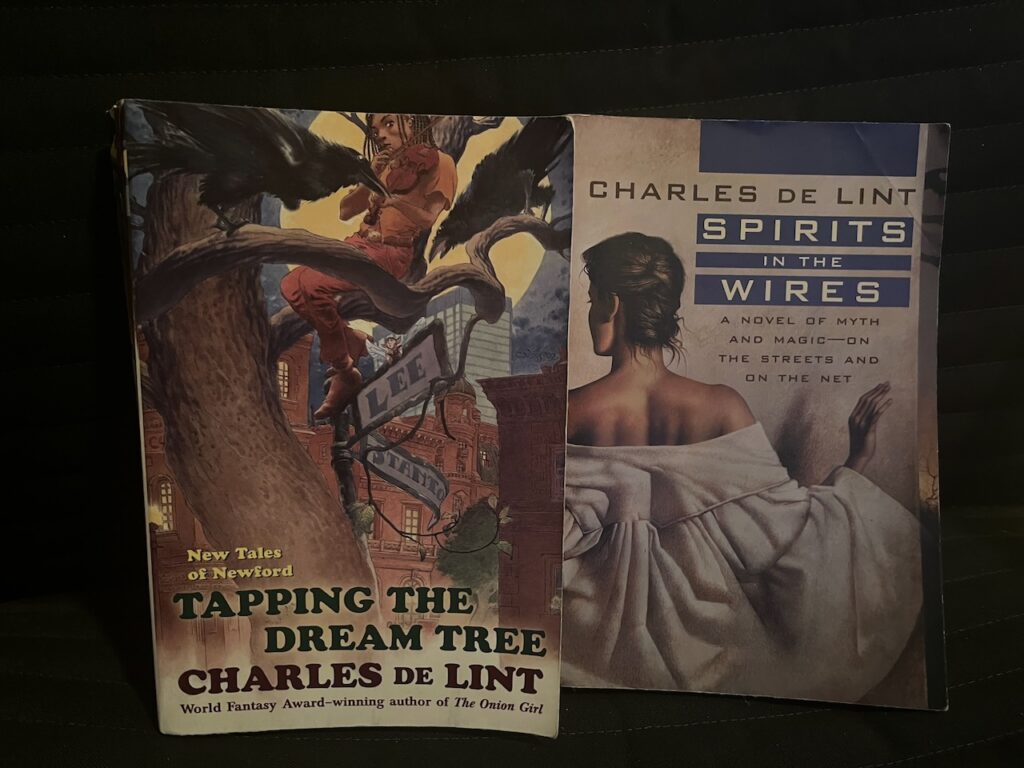
I’ll finish with these two contemporary fantasies by Charles de Lint, both set in his magical realist city of Newford. The first is a selection of short fiction that blends urban life with fantasy in de Lint’s inimitable way, and the second is a novel about a website called the Wildwood that has magical properties. I was especially fascinated with Spirits in the Wires because it depicts an older version of the internet that has been lost to time: an era without social media companies and online megastores dominating every aspect of our online lives, a time of webrings and animated GIFs and MUDs, an age when you could just spin up a website with a rudimentary knowledge of HTML and a server to host it on. It’s a vision of the web, in short, that’s much like the internet that I knew when I was a kid, a boundless resource that may have been irrevocably destroyed by some of the worst people in history.
As an aside, I bought my copy of Spirits in the Wires at the Half Price Books in Lynnwood, and somebody had marked it up in a few places with ballpoint pen. Whoever did this made various grammar corrections, as if trying to show that they were so much smarter than the author. What’s worse, they didn’t even correct the grammar in the right way. It’s perfectly acceptable to use the objective case with comparisons (like more girly than me rather than more girly than I), especially in casual speech, and anyone still sticking to those archaic syntactic rules makes me think of a purse-lipped spinster English teacher with her glasses on a chain, sneering down her nose at her students who have the temerity to split an infinitive or use they as a singular pronoun. Did the existence of more contemporary grammar than was acceptable in 1920 send this person into such paroxysms that they had to write their “corrections” in ink, then donate it to a used bookstore where it could no longer offend them?
At least there weren’t that many comments and this wasn’t a library book. There is a special place in hell for people who ink commentary in library books, alongside those who defile innocence and people who talk in the theater.