Tag: writing thoughts

  • talk to me like humans do

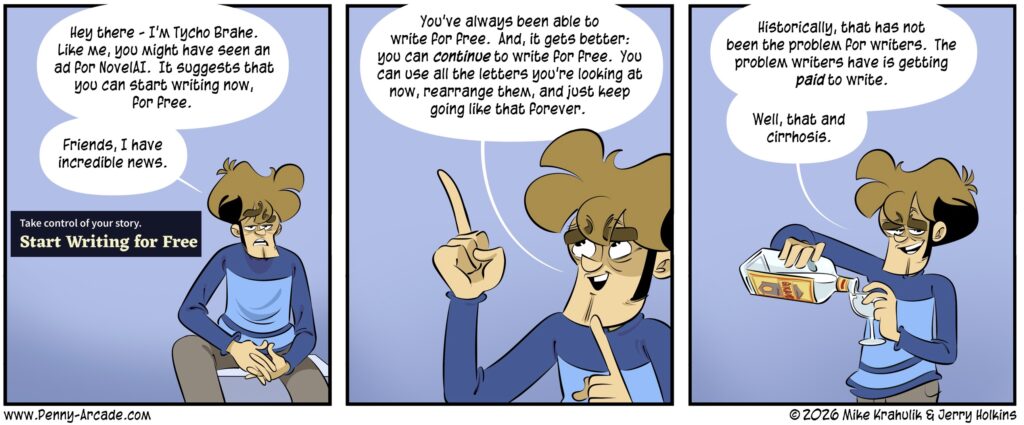
    My friend and fellow Resnick Award nominee Jason Boyd sent me this Penny Arcade comic from a few days ago:
    Screenshot

    That last panel… woof.

    (As a side note, I’ve actually met Jerry Holkins in person. I think that if you spend enough time in tabletop gaming stores in Seattle he will just make himself manifest. As I recall, he was buying Age of Sigmar figurines.)

    Aside from the perils posed by the other issue discussed in that last panel (I speak as someone who has, on occasion, consumed a wee bit too much of humanity’s favorite recreational hydrocarbon), there’s a lot to be said about the act of “creation” under AI that I still have a lot of thoughts about. As far as I can tell, the proponents of AI-based “writing” tools seem to have this belief that the reason writers write is to have a salable produce at the end of it – that the point of writing is to have written. In this worldview, books and stories are entirely fungible, and the act of creation is a burdensome chore. Think of how much time you’ll have, they imply, now that the boring writing part is out of the way!

    I think that, all things considered, if I had more time to write, I would probably spend that time writing.

    Perhaps I should view this narrow, ultracapitalist view of artists and creation as sad, or reprehensible. But I mostly find it confusing. For people who make tools that are ostensibly intended to help artists, I wonder if these tech bro AI proponents have actually ever interacted with an artist in any meaningful way. Or, perhaps, do they only socialize with other brogrammers in their spare time, and their worldview is so warped by that tiny echo chamber?

    This is largely the same reason why I don’t argue with fundamentalist Christians. Not because I think that they’re right, but because it would be impossible. The parameters by which our worldviews operate are so fundamentally different that communication couldn’t exist between us. In order for a discourse to occur, there has to be some kind of consensual reality that we can use as a basis. Otherwise, it would be like trying to discuss which pizza topping is best, only to learn halfway through an increasingly heated argument that when your interlocutor says pizza, they mean small cherrywood box filled with decorative painted thimbles from the Scandinavian region. There is an inherent incompatibility that becomes impossible to overcome.

    If you see nothing fundamentally different between a book written by a human and a hundred thousand words of Markov-chain generated text, maybe AI writing tools are a good idea to you. I suppose they both contain letters and words, and can be held in a .doc file. But if that’s the case, then you must genuinely believe that there is no difference between a human and a Markov-chain computer program, and when you’ve reached that point, our universal parameters are so contradictory that communication between us is impossible.

    ~ Ian (listening to Spine by Myrkur)
  • various thoughts and thinkings, february 2026

    I continue to not be writing very much, at least writing that’s intended to be published in any real form. I don’t know if I’m supposed to feel guilty or not because of that. I assume I shouldn’t, because I don’t feel guilty, but it still feels weird. When I’m in the swing of things, I usually write about a thousand words a day. This doesn’t feel that impressive to me. When I was a teacher in Madrid, I mentioned to one of my fellow auxiliares, a grad student from Swansea in Wales, that every day after school got out, I went to a cafe and wrote 2000 words. He was astonished. “How long does that take you?” he sputtered.

    I was confused. “Like, maybe an hour and a half?”

    “It would take me five hours to write that much! How are you so fast?”

    I shrugged. “Autism.”

    It sounds flippant, but it’s not. My brain’s ability to hyperfixate means that, when I get into the groove of something (especially something I’m interested in), I can block out the entire world and hone in on just that one thing for effectively indefinitely. There are drawbacks, but honestly, considering how they are in so many other ways, it’s surprising to me that neurotypicals can be productive writers. I mean, how can you be productive on a book if you’re spending all your time dating or having a family or a career or such other unnecessary fripperies?

    Still, aside from minor touch-ups on a few short fiction pieces, I haven’t written anything meant for publication in weeks. I was talking with a friend before our biweekly D&D session, however, and she said something that was more profound than I think she realized. “It’s okay to have a fallow period every once in a while,” she told me. I immediately thought, Fallow. What a great metaphor. As I’m sure all history nerds know, in a crop rotation system, a fallow field is hardly unproductive. Rather, it’s a critical part of replenishing the soil with nitrogen so that the field can be even more fertile the next season. Especially if you graze livestock in that fallow field so you can get still have some productivity out of that field that year. I just have to let the goats of daily experience poop in my brain so that my mind-field is re-nitrogenated, thus allowing much more fertile story-crops.

    Does this metaphor make sense? I think this metaphor makes sense.

    In any case, just because my story-field is currently fallow doesn’t mean that I haven’t been creative. Rather, I’ve rotated into writing lore and backstory for my D&D campaign. This is pleasant because there’s not much pressure to perform. My players are some of my best friends. I know that, no matter what, they will be a receptive audience, even if agents and short story markets might not be. Besides, writers love coming up with lore. I can think of several fantasy series that I’m sure primarily exist so the author can tell you all the neat lore they’ve come up with. It certainly can’t be because of the characters or the plots, because they’re not good or interesting. Ideally, I want the lore in my stories to be a side element. But that doesn’t mean that I don’t enjoy making it, and this gives me an excuse.

    Also! I had a conversation with an editor I met at DragonCon this last summer. He’d given me his business card, so I figured that it would be cool to reach out, and he was very kind in letting me ask him questions about the publishing industry and the way it be. Specifically, I wanted to know why, for the last few years, I’ve found it very difficult to get agents to request full manuscripts, when in the past I actually had agents reaching out for more writing rather frequently. He said that it’s not just me. Because of how everything generally is, sales are down across the publishing industry, and as such, agents are far less willing to take chances on unknown writers, especially if the writing defies easy categorization. The most important thing, he said, is to do the same thing that I’m already doing: keep writing, keep revising, keep querying. The number one thing that separates successful from unsuccessful writers is the same as it ever was: sheer, bloody-minded, pig-headed determination.

    At the very least, I can at least rest easy that, as always, there’s nothing wrong with me. It’s capitalism’s fault!

  • the act of creation under late stage capitalism

    My friend Tim makes beer. He’s actually really good at it. He has this beer that he brews with chamomile that, if I had it at a microbrewery or a good pub, I would consider to be one of my favorites of the year. The beers are 100% good enough that you could sell them.

    And yet, every time I hear someone tell Tim that he should sell his brews, my skin crawls a little bit. There are a few reasons for this. One is that the skillset required to make beer and the skillset for operating a microbrewery form a Venn diagram resembling Meszut Özil’s eyes. Making a business of brewing means producing beer at scale, leasing space to do it in, hiring employees, dealing with finances, arranging distribution and marketing… in short, all kinds of things that don’t involve beer and the making thereof. This is why so many microbrewers fail, even if their beer is excellent. Making stuff and selling it are vastly different endeavors.

    But most of the skin-crawly ick that these comments give me comes from something deeper. There’s a casual assumption in society that, if you’re good at something, it’s practically your obligation to monetize it, that creative work is only worth doing if it results in a salable product at the end. Under this paradigm, Tim is actively wasting his time with his homebrew hobby, no matter how much satisfaction the process of brewing gives him, or the joy that his family and friends receive from drinking his beer. Any moment of the day that is not devoted to maintaining basic bodily needs, according to society, is squandered by not squeezing every drop of revenue from it.

    It is a genuine tragedy of our culture that doing something for simple enjoyment is considered frivolous if it doesn’t result in a profit. And that’s what creative work is supposed to be: enjoyable. If you make beer, or knit, or paint, or create incredibly detailed tiny wooden sculptures of Bloom County characters, isn’t the pleasure you get from creation inherently worth it?

    Then I think about myself and my writing, and I get even more conflicted.

    I started writing for a lot of reasons. A lot of it was that I wanted to prove to others that I had value, the asshole students and bullying teachers that I dealt with every day. I thought that being the youngest ever published fantasy writer would win me friends and approval. But once I’d become better at writing, I discovered that I enjoyed it. Everything in my life seemed like work, from school to socializing to just being at home. Because writing didn’t feel like work, I thought that, if I were able to make money doing that, I wouldn’t have to deal with all the difficult life stuff that I hated.

    When I was a teenager, I wanted to write a genre-defining epic fantasy novel like Lord of the Rings. Now my goals are more modest. I just want to make a living as a writer so I don’t have to do that work stuff. I’m not there yet– the only money I’ve made is the $100 from the runner-up prize for the Resnick Award. Part of me, though, thinks that if I don’t end up making money as a writer, all of the work I’ve done, all the millions of words, the unpublished novels and short stories and games I’ve written, will have gone to waste.

    Is that an attitude that I have genuinely? Or have I somehow bought into the cultural delusion that creative work only has value if it’s profitable? I genuinely don’t know. Whatever the reason, that desire is tangled up with a lot of other things: my need for approval, my fear of failure, my wish to make a living without having to do “real work”. I don’t have any easy answers, and this post won’t provide any answers.

    At the very least, it’s hard submitting stories because the publishing industry, as much as it claims to be about literature, is an ultimately capitalist endeavor. The publishing houses, whether they’re Big Five or small press, are in the business of extracting as much money as they can from consumers for the least amount of overhead. This means that publishers and agents are very hesitant to take risks on any new writers or material. They would much rather have something by an established writer whose work is guaranteed to sell, or whatever trend is currently popular. That’s why you saw so many YA vampire romances twenty years ago and dystopian novels ten years ago. Now the trend is for smutty romantasies with titles like A Noun of Nouns and Nouns. It’s harder than ever for new writers to break through.

    Where does the line exist between selling out and selling, though? Do I have to change my work to fit in with current market trends? Ultimately that’s a self-defeating practice: it can take two years for a book to go from sale to publication date, so all those Sarah J. Maas and Rebecca Yarros ripoffs that just got six-figure deals will be hopelessly off-trend when they come out. Is my best bet to just write books I like, write works that I think are valuable, and keep submitting until I find an agent or editor who likes my writing for what it is?

    I don’t know. All I know is that this short-sighted trend chasing from the Big Five publishers contains the seeds of its own destruction. No one can predict what’s going to be a massive success in publishing (hell, just look at Fifty Shades of Grey), so playing it safe and just doing what sells is ultimately doomed. What sells now might not sell in the future. All those copies of Twilight and Fifty Shades are crowding the shelves at Goodwill. Maybe that doesn’t matter to their authors, who are massively wealthy, or the publishers who have already been paid for those copies. But doing what’s easy or safe, while tempting, is a losing strategy in the long run. The publishing industry, as well as society as a whole, has to learn that soon. Otherwise the future will crush it.

    ~ Ian (listening to Bexley by Bexley)

  • finished with my woman cause she couldn’t help me with my mind

    I got some criticism from a reader recently that I’m having trouble getting out of my head. I don’t need to go into the details about who the reader was or what the criticism is. It’s just something that stuck in my head, making me question a lot of things about my writing. And even if I’ve talked with other beta readers who’ve told me, some in emphatic terms, that they disagreed with this reader’s particular analysis, it was still something that I’m hyperfixating on, probably to the detriment of my work.

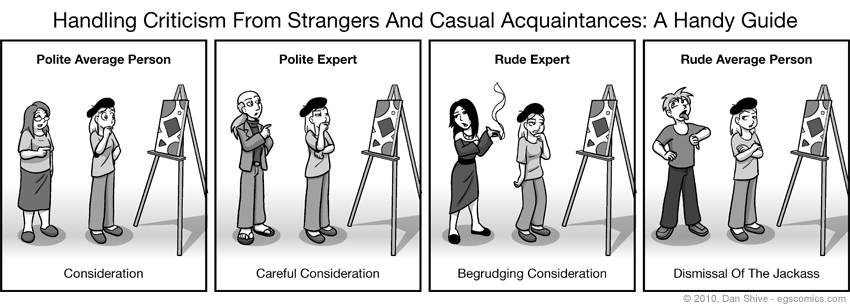
    I know I shouldn’t do this. I don’t know why I put the opinions of someone who doesn’t like my work over the opinions of people who do. I wish that I could kick this paranoia, but it’s hard. If I get too in my head, however, I try to take the advice of this old Dan Shive comic:

    It’s a good idea in theory, but at the same time, hard to put into practice. Having a moderate anxiety disorder means that my paranoia can take over everything I do and lead me to question everything. Of course, I make up for the anxiety with bouts of self-loathing depression. Such is the life of a writer, I suppose.

    Yesterday, I got so pissed off at a novel in progress that I decided to completely change the antagonist and the main character’s backstory. This, of course, is not a small change, and it’s frustrating. If revising a novel is like renovating a house, then I expected to patch some holes in the drywall and repair some faulty plumbing, and instead I have to tear the house down to the foundation and replace the entire roof. This work in progress is one of my favorite things I’ve done, and I love writing scenes with the characters, but ultimately I estimate that I’ll have to completely rewrite about 40% of the book, not to mention revising most of the existing scenes to make it so that everything is consistent.

    I should trust in myself, I know. I’m a good writer, and I’ve had multiple publishing professionals tell me that. I can fix what’s wrong with the story. At the same time, though, I’m angry at myself – even though first drafts aren’t supposed to be perfect, even if the road to a finished product is never easy. Even if the twists and turns I’ve taken on this story have been like pulling teeth.

    Speaking of pulling teeth, I’m going to the dentist tomorrow to get most of the teeth on the upper left side of my mouth fixed. This involves multiple crowns, fillings, possibly root canals – and even that may not solve everything. So my generalized anxiety right now is understandable, I suppose. I’ve learned that autistic people tend to mask when we’re in discomfort or pain, because so often our discomfort is dismissed or minimized. This leads to minor medical problems eventually becoming severe, costing thousands of dollars. At least I have insurance now from my new job, so the bill will be in the three figures rather than the four or five.

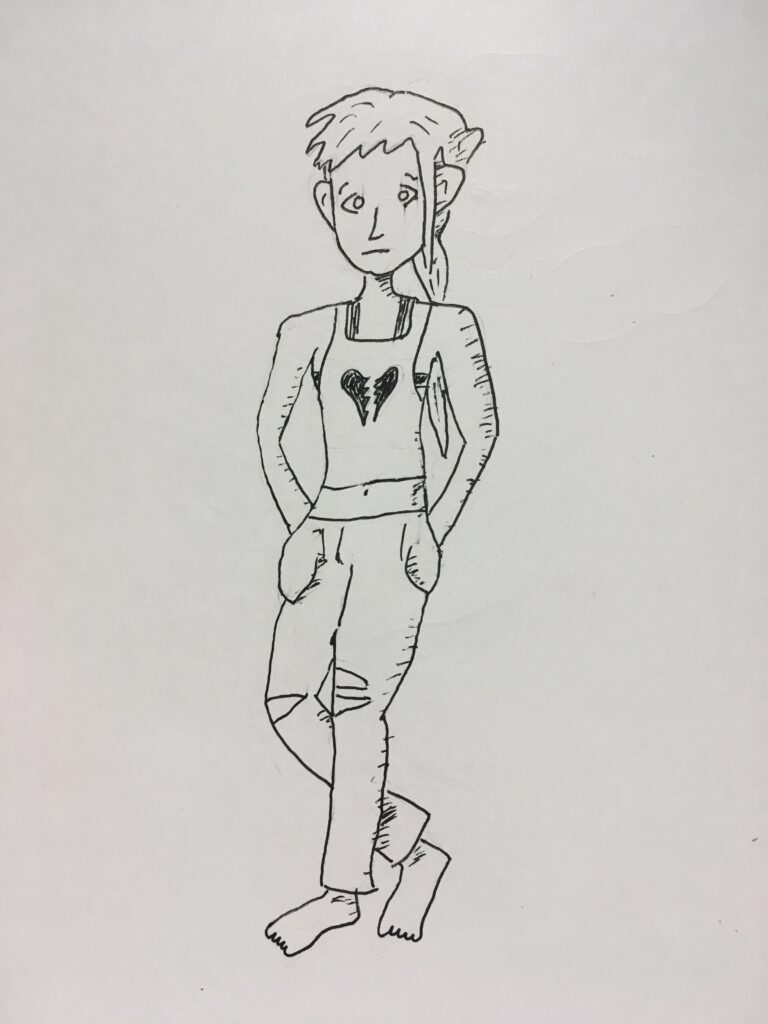
    This has been a bit of a bummer of a blog post, I guess, so I’ll finish it with a drawing I did several years ago. It’s the main character of a very long, complicated writing project that I hope to complete one day. Her name is Sophie. I’m excited for you to know her story.

    ~ Ian (listening to Pogo Rodeo by Psychedelic Porn Crumpets)